 WhatsApp Us (24/7)
 +91 926 888 0303 (24/7)


To Book an Appointment
Call Us+91 926 888 0303Cerebral Arteriovenous Malformations: Causes, Risks and Treatment
By Dr. Rajender Kumar in Radiation Oncology , Cancer Care / Oncology , Head & Neck Oncology
Aug 28 , 2025 | 7 min read
1

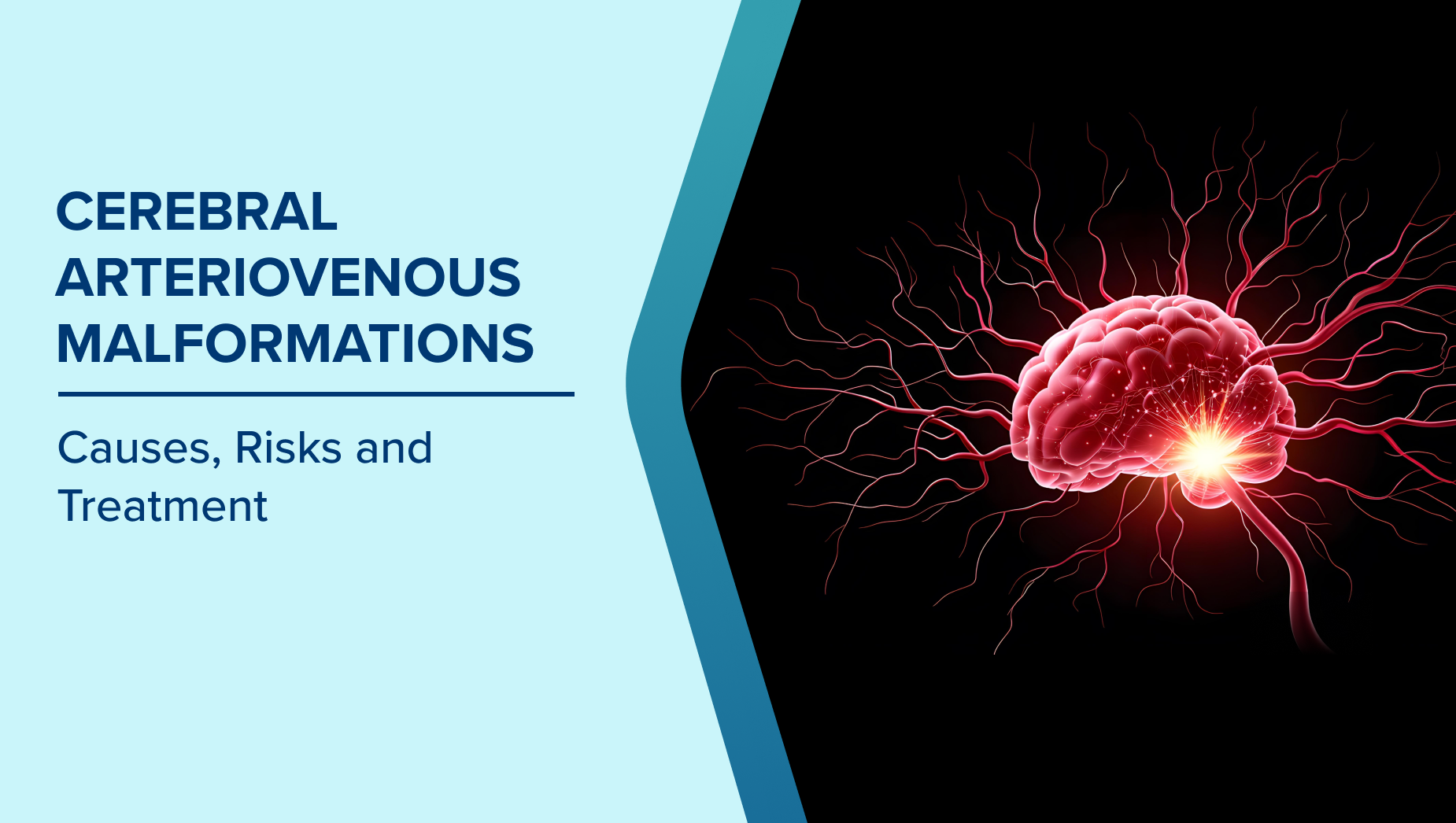
Cerebral Arteriovenous Malformations (AVM) are rare vascular entities with devastating consequences. They are a congenital collection of improperly formed irregular vessels forming a nidus, mainly in the brain that shunts arterial blood at high pressure directly to the venous drainage system leading to life threatening risk of hemorrhage, neurological deficits or seizures. The nidus is defined as the convergence of feeding arteries from which enlarged draining veins emerge.
Global Incidence and Risk
Global incidence rate for arteriovenous malformation is 1 in 100,000 with mortality rate of 10-15% in untreated cases. AVMs account for approximately 1.4-2% of all strokes and 9% of all primary intracranial hemorrhage. In untreated cases, annual hemorrhage risk may be as low as 0.9% per year for unruptured AVMs with superficial drainage, or it may be as high as 34% per year for ruptured AVMs that are deep seated. AVM with associated aneurysms have an overall risk of hemorrhage of 6.93% per year.
Generally, 20 to 30% have some neurologic morbidity and the mortality rates of hemorrhage range from 10-40%; 18% to 40% of patients with AVMs present with a seizure, 5-14% of patients present with a headache without a hemorrhage and 5-15% of patients present with persistent or progressive neurologic deficits.
Diagnostic Imaging and Evaluation
Digital Subtraction Angiography (DSA) or Cerebral angiography is the gold standard for evaluation of AVM architecture. MRI (Magnetic Resonance Imaging) & MRA (Magnetic Resonance Angiography) may provide visualisation of changes to the brain adjacent to the nidus such as perinidal or intranidal gliosis. Blood-oxygen level dependent functional MRI may prove to be helpful in providing information about eloquence in regards to structures in and around AVM.
Why Treatment is Necessary
Treatment is mandated both in unruptured as well as ruptured AVM. The intention for treating AVM’s is to decrease chances of bleeding in future along with prevention of subsequent neurological deficit with risk of 0.9% in case of unruptured AVM’s to 35% in case of ruptured AVM.
Treatment Options for AVM
Surgery
Surgery requires craniotomy and opening of dura and for complete AVM resection, the nidus must be dissected circumferentially. Overall mortality rates are approximately 3.3%, morbidity rates are 8.6%, permanent neurological deficit or death are seen in 7.4% with overall case fatality rates being 1.1 per 100 person years.
Advantages of surgery: High rates of obliteration (~90-95%) and immediate elimination of the risk of hemorrhage with obliteration.
Challenges: Intraoperative rupture, anatomic accessibility, resection of normal tissue, edema from retraction and thrombosis of feeding vessels.
Endovascular Embolization
Endovascular embolization has a case fatality rate of 0.96 per 100 person years and hemorrhage rates of 1.7 per 100 person years. Complications leading to permanent neurologic deficits or death was seen in 6.6% of cases. Overall obliteration rates are 13%.
Benefits: Minimally invasive, may provide immediate occlusion, and intraprocedural angiographic evaluation.
Challenges: Incomplete embolization, swelling, recanalization or haemorrhage.
Stereotactic Radiosurgery (SRS)
Stereotactic radiosurgery is a very good treatment option for obliteration if surgery/ Endovascular embolization is not feasible or in cases where surgery/ Endovascular embolization may increase morbidity or mortality. It is a non-invasive, painless, cost-effective, highly accurate and single-day treatment with results comparable or superior to other treatment options.
Only nidus is treated, not the feeding artery or the draining vein. Obliteration occurs via endothelial damage and thickening of intimal layers followed by thrombosis and necrosis of AVM vessels, which take approximately 2-3 years with a median of 20 months for >95% obliteration. Typically, the dose ranges from 18-24 Gy delivered in a single session to the 50% isodose depending upon the adjacent area of AVM.
Efficacy:
- Excellent control rate of 70%-95% at 3-5 years.
- Case fatality rates are lowest with this mode of treatment at 0.5 per 100 person years.
- Hemorrhage rates with SRS are low at 1.1 per 100 person years.
Best outcomes: AVMs with a small volume in non-critical locations with high doses, which have obliteration rates >90%. Obliteration without a new neurological deficit was seen in more than 90% cases.
Risk reduction: After SRS, risk of hemorrhage decreases by 54-58% during the latency period and by 88-92% after obliteration as compared to the period between diagnosis and radiosurgery.
Other benefit: Feasibility of re-radiation treatment in case of recurrent as well as residual AVM’s, as compared to limited chances of the same with surgery or endovascular embolization.
Follow-Up and Monitoring
Follow-up for AVM involves regular imaging tests and visits with an Oncologist to monitor the AVM's progress and detect any recurrence. For those with unruptured AVMs, a 5-year follow-up is generally recommended, while those who have had surgery or other treatment may need more frequent imaging, such as 6 months and 2 years after treatment.
Cerebral Arteriovenous Malformations (AVM) are rare vascular entities with devastating consequences. They are a congenital collection of improperly formed irregular vessels forming a nidus, mainly in the brain that shunts arterial blood at high pressure directly to the venous drainage system leading to life threatening risk of hemorrhage, neurological deficits or seizures. The nidus is defined as the convergence of feeding arteries from which enlarged draining veins emerge.
Global Incidence and Risk
Global incidence rate for arteriovenous malformation is 1 in 100,000 with mortality rate of 10-15% in untreated cases. AVMs account for approximately 1.4-2% of all strokes and 9% of all primary intracranial hemorrhage. In untreated cases, annual hemorrhage risk may be as low as 0.9% per year for unruptured AVMs with superficial drainage, or it may be as high as 34% per year for ruptured AVMs that are deep seated. AVM with associated aneurysms have an overall risk of hemorrhage of 6.93% per year.
Generally, 20 to 30% have some neurologic morbidity and the mortality rates of hemorrhage range from 10-40%; 18% to 40% of patients with AVMs present with a seizure, 5-14% of patients present with a headache without a hemorrhage and 5-15% of patients present with persistent or progressive neurologic deficits.
Diagnostic Imaging and Evaluation
Digital Subtraction Angiography (DSA) or Cerebral angiography is the gold standard for evaluation of AVM architecture. MRI (Magnetic Resonance Imaging) & MRA (Magnetic Resonance Angiography) may provide visualisation of changes to the brain adjacent to the nidus such as perinidal or intranidal gliosis. Blood-oxygen level dependent functional MRI may prove to be helpful in providing information about eloquence in regards to structures in and around AVM.
Why Treatment is Necessary
Treatment is mandated both in unruptured as well as ruptured AVM. The intention for treating AVM’s is to decrease chances of bleeding in future along with prevention of subsequent neurological deficit with risk of 0.9% in case of unruptured AVM’s to 35% in case of ruptured AVM.
Treatment Options for AVM
Surgery
Surgery requires craniotomy and opening of dura and for complete AVM resection, the nidus must be dissected circumferentially. Overall mortality rates are approximately 3.3%, morbidity rates are 8.6%, permanent neurological deficit or death are seen in 7.4% with overall case fatality rates being 1.1 per 100 person years.
Advantages of surgery: High rates of obliteration (~90-95%) and immediate elimination of the risk of hemorrhage with obliteration.
Challenges: Intraoperative rupture, anatomic accessibility, resection of normal tissue, edema from retraction and thrombosis of feeding vessels.
Endovascular Embolization
Endovascular embolization has a case fatality rate of 0.96 per 100 person years and hemorrhage rates of 1.7 per 100 person years. Complications leading to permanent neurologic deficits or death was seen in 6.6% of cases. Overall obliteration rates are 13%.
Benefits: Minimally invasive, may provide immediate occlusion, and intraprocedural angiographic evaluation.
Challenges: Incomplete embolization, swelling, recanalization or haemorrhage.
Stereotactic Radiosurgery (SRS)
Stereotactic radiosurgery is a very good treatment option for obliteration if surgery/ Endovascular embolization is not feasible or in cases where surgery/ Endovascular embolization may increase morbidity or mortality. It is a non-invasive, painless, cost-effective, highly accurate and single-day treatment with results comparable or superior to other treatment options.
Only nidus is treated, not the feeding artery or the draining vein. Obliteration occurs via endothelial damage and thickening of intimal layers followed by thrombosis and necrosis of AVM vessels, which take approximately 2-3 years with a median of 20 months for >95% obliteration. Typically, the dose ranges from 18-24 Gy delivered in a single session to the 50% isodose depending upon the adjacent area of AVM.
Efficacy:
- Excellent control rate of 70%-95% at 3-5 years.
- Case fatality rates are lowest with this mode of treatment at 0.5 per 100 person years.
- Hemorrhage rates with SRS are low at 1.1 per 100 person years.
Best outcomes: AVMs with a small volume in non-critical locations with high doses, which have obliteration rates >90%. Obliteration without a new neurological deficit was seen in more than 90% cases.
Risk reduction: After SRS, risk of hemorrhage decreases by 54-58% during the latency period and by 88-92% after obliteration as compared to the period between diagnosis and radiosurgery.
Other benefit: Feasibility of re-radiation treatment in case of recurrent as well as residual AVM’s, as compared to limited chances of the same with surgery or endovascular embolization.
Follow-Up and Monitoring
Follow-up for AVM involves regular imaging tests and visits with an Oncologist to monitor the AVM's progress and detect any recurrence. For those with unruptured AVMs, a 5-year follow-up is generally recommended, while those who have had surgery or other treatment may need more frequent imaging, such as 6 months and 2 years after treatment.
Written and Verified by:

Related Blogs


Dr. Charu Garg In Radiation Oncology , Cancer Care / Oncology , Breast Cancer
Sep 20 , 2017 | 3 min read
Blogs by Doctor

Most read Blogs


Related Blogs
Dr. Charu Garg In Radiation Oncology , Cancer Care / Oncology , Breast Cancer
Sep 20 , 2017 | 3 min read
Blogs by Doctor
Most read Blogs