 व्हाट्सऐप करें (24/7)
 +91 926 888 0303 (24/7)


सार:इन बदलती परिस्थितियों ने इन विट्रो फर्टिलाइजेशन (आईवीएफ) के लिए संकेतों का विस्तार किया है, जिसमें अंडाणु को शरीर के बाहर निषेचित किया जाता है। कैंसर के रोगियों में प्रजनन क्षमता संरक्षण, आनुवंशिक बीमारी को दूर करने के लिए भ्रूण बायोप्सी, और एचआईवी और हेपेटाइटिस जैसे वायरल संक्रमणों को कम करने के लिए कुछ नए संकेत हैं। ब्लास्टोसिस्ट कल्चर, लेजर असिस्टेड हैचिंग, माइक्रोटीसे द्वारा टेस्टिकुलर स्पर्म रिट्रीवल, युवा लड़कियों में प्रजनन क्षमता संरक्षण के लिए ओवेरियन टिश्यू फ्रीजिंग और स्टेम कोशिकाओं के साथ पुनर्योजी दवाएं जैसी विशेष प्रक्रियाओं का हाल ही में उपयोग किया जाने लगा है। आईवीएफ एक स्वीकार्य प्रक्रिया है जिसकी सफलता दर बहुत अधिक है। समय के साथ इसके लाभों को मान्यता मिलने के कारण, यह अब अधिक आसानी से उपलब्ध है और इसके संकेत भी व्यापक हो गए हैं।
मुख्य शब्द:इन विट्रो फर्टिलाइजेशन, माइक्रोटीसे, आईसीएसआई, फर्टिलिटी प्रिजर्वेशन
परिचय
आजकल, शादी और बच्चे पैदा करने में देरी होने के कारण, बांझपन एक आम समस्या बन गई है। इन बदलती परिस्थितियों के कारण, इन विट्रो फर्टिलाइजेशन (आईवीएफ) की आवश्यकता बढ़ गई है, जिसमें अंडाणु को शरीर के बाहर निषेचित किया जाता है। फिर, बनने वाला भ्रूण गर्भाशय में प्रत्यारोपित किया जाता है। आईवीएफ में प्रयोगशाला में अंडाणु और शुक्राणु को संभाला जाता है, और यह सहायक प्रजनन तकनीकों में से एक है।
पुरुषों में बांझपन की दर 25% से बढ़कर 40% हो गई है, और पिछले कुछ वर्षों में शुक्राणु की संख्या और अन्य मापदंडों में गिरावट आई है। ऐसे में, पुरुषों में शुक्राणु की गुणवत्ता में कमी या शुक्राणुओं की पूरी तरह से अनुपस्थिति देखी जा सकती है। कम शुक्राणु की संख्या होने पर आईवीएफ (IVF) किया जा सकता है, लेकिन शुक्राणुओं की अनुपस्थिति वाले मामलों में उपचार अधिक चुनौतीपूर्ण होता है। बांझपन, यौन संबंध स्थापित करने में असमर्थता से अलग है, क्योंकि बाद वाले मामले में शुक्राणु की संख्या सामान्य होती है। डब्ल्यूएचओ (WHO) ने शुक्राणु के मूल्यांकन के लिए एक मानक निर्धारित किया है। शुक्राणु की संख्या कम से कम 39 मिलियन प्रति वीर्य होनी चाहिए। शुक्राणुओं की गतिशीलता 42% होनी चाहिए, जिसमें 30% सक्रिय रूप से गतिशील हों। शुक्राणु की आकृति सामान्य होनी चाहिए (यानी, सिर, मध्य भाग और पूंछ का आकार सामान्य होना चाहिए) और इसका विश्लेषण किए गए शुक्राणुओं में कम से कम 4% में होना चाहिए। यह महत्वपूर्ण है कि किसी प्रशिक्षित व्यक्ति द्वारा ही शुक्राणु का विश्लेषण किया जाए, क्योंकि हर कोई आकार संबंधी दोषों का निदान नहीं कर सकता है। इसके अलावा, वीर्य की मात्रा, पीएच और फ्रुक्टोज का भी विश्लेषण किया जाता है।1. What are the different types of surgeries offered at Max Hospital? 2. What is the cost of a kidney transplant at Max Hospital? 3. What are the qualifications of the surgeons at Max Hospital? 4. What is the success rate of surgeries at Max Hospital? 5. What are the risks and complications associated with surgeries at Max Hospital? 6. What is the recovery process after surgery at Max Hospital? 7. What are the different types of anesthesia used during surgeries at Max Hospital? 8. What are the different types of pain management techniques used after surgery at Max Hospital? 9. What are the different types of rehabilitation programs offered after surgery at Max Hospital? 10. What are the different types of follow-up care provided after surgery at Max Hospital?
आईवीएफ के संकेत।
1. महिला-संबंधी कारणों से होने वाली बांझपन की स्थिति में आईवीएफ के संकेत:आईवीएफ़ तब किया जाता है जब फैलोपियन ट्यूब में रुकावट हो, जैसे कि गंभीर एंडोमेट्रियोसिस या पेल्विक इंफ्लेमेटरी डिजीज के मामले में। शरीर के अंदर निषेचन संभव नहीं होता है। कम ओवेरियन रिज़र्व वाली वृद्ध महिलाओं को गर्भधारण करने के लिए आईवीएफ़ की आवश्यकता हो सकती है। पॉलीसिस्टिक ओवेरियन डिजीज या अस्पष्टीकृत बांझपन वाली महिलाओं, जो इंट्रायूटेराइन इनसेमिनेशन (आईयूआई) जैसी ट्रीटमेंट पर प्रतिक्रिया नहीं दे रही हैं, उन्हें आईवीएफ़ की आवश्यकता हो सकती है। जिन महिलाओं में समय से पहले मेनोपॉज़ हो गया है, उनके लिए डोनर ओओसाइट के साथ आईवीएफ़ एक विकल्प है। उन महिलाओं में जिनमें गर्भाशय अनुपस्थित/निकाल दिया गया है या गर्भाशय में घने इंट्रायूटेराइन एडहेसन हैं जो गर्भाशय की गुहा को विकृत करते हैं, या गंभीर हृदय रोग जैसी स्वास्थ्य संबंधी कारणों से गर्भावस्था निषिद्ध है, सरोगेसी के माध्यम से आईवीएफ़ की सिफारिश की जाती है।
2. पुरुषों में बांझपन के लिए आईवीएफ के संकेत:आईवीएफ उन पुरुषों के लिए उपयुक्त है जिनमें शुक्राणु की संख्या और गतिशीलता कम होती है। चूंकि शुक्राणु गतिशील नहीं होते हैं, इसलिए प्राकृतिक निषेचन संभव नहीं है। शुक्राणुओं को सीधे माइक्रोस्कोप के नीचे एक माइक्रोनीडल का उपयोग करके अंडाणु में इंजेक्ट किया जाता है, इस प्रक्रिया को इंट्रासाइटोप्लाज्मिक स्पर्म इंजेक्शन (आईसीएसआई) कहा जाता है। उन बांझ पुरुषों में जिनमें शुक्राणु अनुपस्थित होते हैं (एज़ोस्पर्मिया), शुक्राणु को शल्य चिकित्सा द्वारा वृषण से प्राप्त किया जाता है। तनाव, धूम्रपान और लंबे समय तक चलने वाली बीमारी कुछ सामान्य कारक हैं। बचपन में खसरा, वृषण का अवरोहण न होना या वृषण में आघात जैसे कारण हो सकते हैं। मस्तिष्क ट्यूमर या संक्रमण भी शुक्राणु की संख्या को प्रभावित कर सकते हैं। ऐसी दवाएं जो बांझपन का कारण बन सकती हैं, उनमें टेस्टोस्टेरोन, एनाबॉलिक स्टेरॉयड (जो पुरुष मांसपेशियों को बनाने के लिए लेते हैं, खासकर जिम में प्रशिक्षकों द्वारा इस उद्देश्य के लिए दिए जाते हैं), कीमोथेरेपी, एंटीहाइपरटेंसिव, सिमेटिडाइन, डिलेंटिन, एरिथ्रोमाइसिन आदि शामिल हैं। स्थानीय कारणों में वृषण में बढ़ी हुई नसें, जिन्हें वेरीकोसेल कहा जाता है, स्थानीय तापमान को बढ़ा सकती हैं और शुक्राणुओं को नष्ट कर सकती हैं, जो तापमान के प्रति संवेदनशील होते हैं। आनुवंशिक कारण भी हो सकते हैं, जैसे वाई क्रोमोसोम माइक्रोडिलीशन और क्लाइनफेल्टर सिंड्रोम। शुक्राणु को ले जाने वाली नली (वास डिफेरेंस) जन्म से या बाद में होने वाले संक्रमण के कारण अवरुद्ध हो सकती है। प्रजनन पथ के संक्रमण शुक्राणु उत्पादन और गुणवत्ता को प्रभावित कर सकते हैं। कुछ मामलों में, वीर्य स्खलित होने के बजाय मूत्रमार्ग में चला जाता है, जिसे रेट्रोग्रेड स्खलन कहा जाता है। इन मामलों में, मूत्र से शुक्राणु एकत्र किया जाता है और अंडाणु पर आईसीएसआई किया जाता है।
3. भविष्य में प्रजनन क्षमता को बनाए रखने के लिए आईवीएफ के संकेत:महिलाओं में उम्र बढ़ने के साथ-साथ अंडों की संख्या धीरे-धीरे कम होती जाती है, जिसके कारण अधिक उम्र में अंडों की कमी हो जाती है। जो महिलाएं अविवाहित हैं या गर्भावस्था की योजना नहीं बना रही हैं, उनके लिए ओओसाइट फ्रीजिंग का विकल्प उपलब्ध है, जिससे उनकी प्रजनन क्षमता को बनाए रखा जा सके।2ओओसाइट फ्रीजिंग उन आनुवंशिक स्थितियों में भी अनुशंसित है जो समय से पहले रजोनिवृत्ति का कारण बनती हैं, जैसे कि फ्रेजाइल एक्स सिंड्रोम और टर्नर सिंड्रोम (मोज़ेक)।3अंडाशय से ओओसाइट्स निकाले जाते हैं और उन्हें तरल नाइट्रोजन में जमाया जाता है, ताकि बाद में उन्हें पिघलाकर निषेचित किया जा सके और गर्भावस्था स्थापित की जा सके।
ऑन्कोफर्टिलिटी:कैंसर से पीड़ित पेशेंट्स में प्रजनन क्षमता को सुरक्षित रखने के बारे में जागरूकता बढ़ रही है। कैंसर के ट्रीटमेंट में कीमोथेरेपी और रेडियोथेरेपी का अंडाणु भंडार और शुक्राणु बनाने की क्षमता पर असर पड़ता है। इन थेरेपीज़ से पहले, उन्हें ओओसाइट, शुक्राणु या भ्रूण संरक्षण कराने की सलाह दी जाती है, जिसका उपयोग पेशेंट्स भविष्य में गर्भावस्था के लिए कर सकते हैं। इन्हें कई वर्षों तक जमा करके रखा जाता है और कैंसर के ठीक होने के बाद इस्तेमाल किया जा सकता है। चूंकि परिवार होने से जीवन की गुणवत्ता पर असर पड़ता है, इसलिए इन पेशेंट्स को प्रजनन क्षमता को सुरक्षित रखने के लिए प्रोत्साहित करना ज़रूरी है। हाल ही में, ओवेरियन टिश्यू फ्रीजिंग को प्रजनन क्षमता को सुरक्षित रखने के एक स्वीकार्य तरीके के रूप में मान्यता दी गई है। कैंसर के ट्रीटमेंट से गुजर रही युवा महिलाओं और प्री-एडोलेसेंट लड़कियों में प्रजनन क्षमता को बनाए रखने के लिए ओवेरियन टिश्यू को जमा करके रखा जाता है।4बाद में, जब वे एक परिवार चाहते हैं, तो इस जमे हुए ओवेरियन टिश्यू को पिघलाया जाता है और वापस ट्रांसप्लांट किया जाता है। इस प्रक्रिया के बाद प्राकृतिक और आईवीएफ दोनों तरह की गर्भावस्थाएं हो सकती हैं। यह प्री-एडोलेसेंट लड़कियों में प्रजनन क्षमता को बनाए रखने के लिए उपलब्ध एकमात्र तकनीक है, जहां अंडे निकाले नहीं जा सकते हैं। इसका एक फायदा यह है कि यह तुरंत किया जा सकता है, जबकि अंडे को फ्रीज करने में 9-10 दिनों तक उत्तेजना की आवश्यकता होती है और कीमोथेरेपी में देरी हो सकती है।
4. आनुवंशिक परीक्षण के लिए आईवीएफ का संकेत:उन जोड़ों के लिए उम्मीद है जिनमें से एक या दोनों साथी किसी आनुवंशिक बीमारी से पीड़ित हैं, जिसे वे अपने बच्चे में दे सकते हैं। प्रीइम्प्लांटेशन जेनेटिक टेस्टिंग एक ऐसी विधि है जिसमें आईवीएफ से बने भ्रूण से कोशिकाएं निकाली जाती हैं और उस सामग्री को आनुवंशिक विश्लेषण के लिए भेजा जाता है। एक बार रिपोर्ट आने के बाद, सामान्य आनुवंशिक संरचना वाले भ्रूण को गर्भाशय में स्थानांतरित किया जाता है, जिससे यह सुनिश्चित होता है कि एक स्वस्थ बच्चे का जन्म हो। यह उन मामलों में भी उपयोगी है जहां बार-बार आईवीएफ विफल हो जाता है या गर्भपात होता है, ताकि आनुवंशिक कारण को दूर किया जा सके।5
5. संक्रामक बीमारियों के लिए आईवीएफ का उपयोग।ऐसे जोड़ों में जहाँ एक साथी एचआईवी पॉजिटिव या हेपेटाइटिस बी या सी पॉजिटिव है, प्राकृतिक रूप से गर्भधारण करने से दूसरे साथी और बच्चे को संक्रमण का खतरा हो सकता है।6, 7शुक्राणु को धोकर अंडाणु में इंजेक्ट करने से महिला और बच्चे में संक्रमण फैलने की संभावना कम हो जाती है।
प्रक्रिया
आईवीएफ प्रक्रिया के चरण
इस प्रक्रिया में, ओवरी को उत्तेजित करने के लिए प्रतिदिन एफएसएच (FSH) के इंजेक्शन दिए जाते हैं, जिससे कई ओवेरियन फॉलिकल्स विकसित होते हैं। फिर ट्रांसवेजिनली एस्पिरेशन के माध्यम से ओसाइट्स (oocytes) निकाले जाते हैं। इन ओसाइट्स को शरीर के बाहर एक डिश में निषेचित किया जाता है। निषेचित ओसाइट्स से भ्रूण विकसित होते हैं। फिर एक या अधिक भ्रूणों को गर्भाशय में स्थानांतरित किया जाता है, जहाँ उनमें से एक प्रत्यारोपित हो सकता है और गर्भावस्था हो सकती है। पेशेंट को प्रक्रिया, लागत, दवा, सफलता दर और जटिलताओं के बारे में जानकारी दी जाती है। जोखिमों, लाभों, विकल्पों और सफलता दरों को समझाने वाली एक लिखित सहमति प्राप्त की जाती है।
1. फॉलिकल स्टिमुलेटिंग हार्मोन के साथ ओवेरियन स्टिमुलेशन।
दैनिक एफएसएच इंजेक्शन के माध्यम से नियंत्रित ओवेरियन स्टिमुलेशन से सभी मौजूद फॉलिकल्स का विकास होता है। ओवेरियन स्टिमुलेशन का मुख्य उद्देश्य सही दवा को उचित खुराक में देना है, जो पेशेंट की विशेषताओं के अनुरूप हो, ताकि ओवेरियन हाइपरस्टिम्यूलेशन या खराब प्रतिक्रिया के कारण साइकिल रद्द होने जैसी दुष्प्रभावों को कम किया जा सके, बिना गर्भावस्था की संभावना को कम किए। इसका पहला कदम पेशेंट की प्रतिक्रिया की भविष्यवाणी करने वाले कारकों की पहचान करना है। व्यक्तिगत दृष्टिकोण पिछली साइकिल की प्रतिक्रिया, वजन/बॉडी मास इंडेक्स (बीएमआई), उम्र, एंटी-मुलरियन हार्मोन (एएमएच), एंट्रल फॉलिकल काउंट और दिन 2 के हार्मोन जैसे ओवेरियन रिज़र्व मार्कर और बांझपन के कारण (पीसीओएस, एंडोमेट्रियोसिस आदि), पिछली ओवेरियन सर्जरी जैसे अन्य कारकों पर निर्भर करेगा, जो यह निर्धारित करते हैं कि पेशेंट खराब प्रतिक्रिया देने वाला है या अति-प्रतिक्रिया देने वाला।
i. पिछली प्रक्रिया पर प्रतिक्रिया:अक्सर, व्यक्तिगत उपचार पिछले चक्र के प्रदर्शन पर आधारित होता है। यदि पिछली खुराक से अच्छे परिणाम मिले, तो उसे दोहराया जा सकता है, लेकिन यदि पिछले चक्र से अच्छे परिणाम नहीं मिले, तो चक्र का विश्लेषण करना और दवा की खुराक और प्रोटोकॉल में आवश्यक बदलाव करना ज़रूरी है। यदि कोई पिछला चक्र नहीं रहा है, तो अन्य कारकों और अनुभव के आधार पर निर्णय लिया जाता है।
ii. महिला की उम्र:रिप्रोडक्टिव मेडिसिन के डॉक्टर अक्सर महिला की उम्र के आधार पर गोनाडोट्रोफिन की शुरुआती खुराक निर्धारित करते हैं, और उम्र के साथ यह खुराक आनुपातिक रूप से बढ़ाते हैं। हालांकि, उम्र बढ़ने के साथ अंडाशय को उत्तेजित करने की महिला की क्षमता कम हो जाती है, लेकिन केवल उम्र ही अंडाशय की प्रतिक्रिया का विश्वसनीय संकेतक नहीं है। इसके अलावा, समान उम्र की महिलाओं में भर्ती किए जा सकने वाले एन्ट्राल् फॉलिकल्स की संख्या में काफी भिन्नता हो सकती है, जिससे केवल उम्र के आधार पर अंडाशय को उत्तेजित करने की खुराक निर्धारित करने के तर्क पर सवाल उठता है।
iii. वज़न और बीएमआई:यह पाया गया कि जिन पेशेंट्स का बीएमआई (बॉडी मास इंडेक्स) अधिक है, उन्हें अधिक मात्रा में गोनाडोट्रोपिन की आवश्यकता होती है। इसलिए, इन महिलाओं को उच्च खुराक से ट्रीटमेंट शुरू करना चाहिए।8अध्ययनों से पता चला है कि प्राप्त होने वाले ओओसाइट की संख्या में कोई अंतर नहीं दिखता है, लेकिन बढ़ते बीएमआई के साथ ओओसाइट की गुणवत्ता खराब होती है, जिसके परिणामस्वरूप नैदानिक गर्भावस्था की दर कम हो जाती है। मोटे पेशेंट्स को आईवीएफ शुरू करने से पहले वजन कम करने के लिए प्रोत्साहित किया जाना चाहिए।
iv. ओवेरियन रिज़र्व मार्कर:चूंकि पेशेंट की प्रतिक्रिया की भविष्यवाणी ओवेरियन रिज़र्व मार्करों पर निर्भर करती है, इसलिए यह महत्वपूर्ण है कि अधिक संवेदनशील मार्करों और कम संवेदनशील मार्करों के बीच अंतर किया जाए, ताकि कोई निर्णय लेते समय सही जानकारी मिल सके। कम ओवेरियन रिज़र्व पैरामीटर वाली महिलाओं को ट्रीटमेंट शुरू करने से पहले खराब प्रतिक्रिया की संभावना के बारे में सलाह दी जानी चाहिए। इससे महिलाओं को तैयारी करने में मदद मिलती है और ट्रीटमेंट छोड़ने की दर कम होती है। ओवेरियन रिज़र्व टेस्ट के आधार पर किसी भी महिला को स्टिमुलेशन के पहले प्रयास से वंचित नहीं किया जाना चाहिए, क्योंकि इन टेस्ट की सटीकता गर्भावस्था की खराब भविष्यवाणी कर सकती है। कुछ ओओसाइट्स के साथ भी, विशेष रूप से युवा महिलाओं में गर्भावस्था हो सकती है। महिलाओं में प्राप्त किए जा सकने वाले ओओसाइट्स की अधिकतम संख्या ओवरी में मौजूद रिक्रूट करने योग्य एन्ट्राल् फॉलिकल्स की संख्या से दृढ़ता से सीमित होती है, और यह स्पष्ट है कि अधिकतम से अधिक गोनाडोट्रोपिन खुराक फॉलिकल्स की कमी की भरपाई नहीं करेगी।
एफएसएच स्टिमुलेशन की खुराक: सामान्य रूप से, एफएसएच की शुरुआती खुराक 225 आईयू होती है। एएमएच स्तर बढ़ने पर गोनाडोट्रोपिन की शुरुआती खुराक कम हो जाती है, और आईवीएफ में, उच्च प्रतिक्रिया देने वाली महिलाओं के लिए 150 आईयू और कम प्रतिक्रिया देने वाली महिलाओं के लिए 300 आईयू की खुराक की सिफारिश की जाती है। एफएसएच इंजेक्शन की खुराक हर पेशेंट के लिए अलग-अलग हो सकती है; अच्छी ओवेरियन रिज़र्व और एएमएच वाली एक युवा महिला को, उन महिलाओं की तुलना में कम खुराक की आवश्यकता होगी जिनकी उम्र अधिक है और जिनके अंडों की संख्या कम हो रही है। इसी तरह, कम बीएमआई वाली पतली महिला को, अधिक वजन वाली महिला की तुलना में उत्तेजना के लिए कम इंजेक्शन की आवश्यकता होगी।
2. स्टिमुलेशन के प्रति प्रतिक्रिया की निगरानी करना।
ओवेरियन फॉलिकल्स की ट्रांसवेजिनल अल्ट्रासाउंड इमेजिंग के साथ सीरम एस्ट्रैडियोल के क्रमिक माप के माध्यम से उत्तेजना के प्रति प्रतिक्रिया की निगरानी की जाती है। प्रतिक्रिया का आकलन करने और यह निर्धारित करने के लिए कि क्या चयनित खुराक में गोनाडोट्रोपिन की आवश्यकता है, आमतौर पर उत्तेजना के 4-5 दिनों के बाद पहला सीरम एस्ट्रैडियोल स्तर प्राप्त किया जाता है। इसके बाद, प्रतिक्रिया की गुणवत्ता और गोनाडोट्रोपिन उपचार की खुराक में किसी भी आगे समायोजन के प्रभाव का मूल्यांकन करने की आवश्यकता के आधार पर, हर 3 दिनों में ओवेरियन अल्ट्रासाउंड किया जाता है ताकि फॉलिकल के आकार की निगरानी की जा सके। अधिकांश महिलाओं को उत्तेजना के कुल 9-10 दिनों की आवश्यकता होती है। सामान्य तौर पर, लक्ष्य यह है कि कम से कम 3 फॉलिकल्स 17-18 मिमी के औसत व्यास के हों, आदर्श रूप से कुछ अन्य 14-16 मिमी की सीमा में हों, और सीरम एस्ट्रैडियोल की सांद्रता समग्र आकार और फॉलिकल्स के परिपक्वता के अनुरूप हो (लगभग 200 पीजी/एमएल प्रति फॉलिकल जो 14 मिमी या उससे अधिक है)। (चित्र 1)
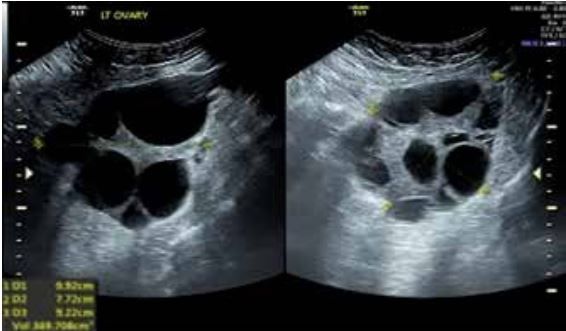
चित्र 1:अल्ट्रासाउंड पर उत्तेजित अंडाशय में फॉलिकल्स की निगरानी।
3. ओव्यूलेशन ट्रिगर
9-10 दिनों तक इंजेक्शन देने के बाद, फॉलिकल्स का व्यास 18 मिमी तक पहुँच जाता है, जिससे यह पता चलता है कि इसके अंदर मौजूद ओओसाइट परिपक्व है। ह्यूमन कोरियोनिक गोनाडोट्रोफिन (एचसीजी) या जीएनआरएच एगोनिस्ट का इंजेक्शन अंतिम रूप से परिपक्वता को बढ़ावा देने के लिए दिया जाता है।
4. ओओसाइट रिट्रीवल
ओओसाइट पिक-अप इंजेक्शन देने के 34-36 घंटे बाद करने की योजना है। ओओसाइट रिट्रीवल जनरल एनेस्थीसिया के तहत ट्रांसवेजिनल रूट के माध्यम से किया जाता है, जिसमें अल्ट्रासाउंड मार्गदर्शन में सुई से फॉलिकल्स में छेद किया जाता है। ओओसाइट्स को नेगेटिव प्रेशर के साथ सुई में चूसा जाता है और एक टेस्ट ट्यूब में इकट्ठा किया जाता है, जिसे प्रयोगशाला को सौंप दिया जाता है। तापमान को सख्ती से 37 डिग्री सेल्सियस पर बनाए रखा जाता है।
5. इनसेमिनेशन और एम्ब्रियो ग्रेडिंग।
तैयार किए गए वीर्य की बूंदों में मिलाकर ओओसाइट को एक डिश में निषेचित किया जाता है। इसे 3 से 5 दिनों तक 37 डिग्री सेल्सियस पर इनक्यूबेटर में रखा जाता है। पहले दिन निषेचन की जांच की जाती है। तीसरे या पांचवें दिन एम्ब्रियो ट्रांसफर कैथेटर के माध्यम से गर्भाशय में एम्ब्रियो को स्थानांतरित करने की योजना बनाई जाती है। एम्ब्रियो को उनकी गुणवत्ता के अनुसार वर्गीकृत करना और स्थानांतरण के लिए सर्वोत्तम गुणवत्ता वाले एम्ब्रियो को अलग करना महत्वपूर्ण है।
6. एम्ब्रियो ट्रांसफ़र
एम्ब्रियो ट्रांसफ़र, आईवीएफ़ की अंतिम और सबसे महत्वपूर्ण प्रक्रिया है। यदि यह सही व्यक्ति द्वारा उचित माहौल में और सभी आवश्यक सावधानियां बरतते हुए नहीं की जाती है, तो इससे आईवीएफ़ चक्र विफल हो सकता है।
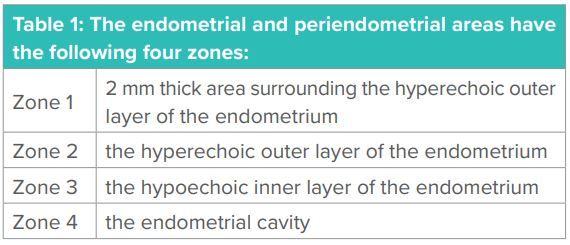
एम्ब्रियो ट्रांसफ़र के लिए ज़रूरी शर्तें:गर्भाशय और एंडोमेट्रियम का मूल्यांकन करना बहुत महत्वपूर्ण है ताकि यह सुनिश्चित किया जा सके कि आईवीएफ शुरू करने से पहले गर्भाशय गुहा और एंडोमेट्रियम का मूल्यांकन किया जाए, क्योंकि यदि कोई रोग है, तो भ्रूण स्थानांतरण के बाद प्रत्यारोपित नहीं होगा। एक सामान्य गर्भाशय गुहा होनी चाहिए जिसमें कोई पॉलीप, आसंजन या सेप्टम न हो। यदि गर्भाशय में फाइब्रॉएड हैं, तो उनके आकार और स्थान का मूल्यांकन करना महत्वपूर्ण है। यदि फाइब्रॉएड बड़ा है या गर्भाशय गुहा को दबा रहा है, तो इसे हटाने की आवश्यकता होती है। एंडोमेट्रियम कम से कम 8 मिमी मोटा होना चाहिए और इसमें अच्छा रक्त प्रवाह और आकार होना चाहिए। एंडोमेट्रियम में 4 क्षेत्र पहचाने गए हैं और सबसे अंदरूनी क्षेत्रों में रक्त प्रवाह मौजूद होना चाहिए (टेबल 1)। एंडोमेट्रियम में रक्त प्रवाह का मूल्यांकन डोप्लर अल्ट्रासाउंड द्वारा किया जा सकता है (चित्र 2)। यदि एंडोमेट्रियम इष्टतम नहीं है, तो भ्रूण स्थानांतरण को अगले चक्र तक स्थगित कर देना चाहिए।
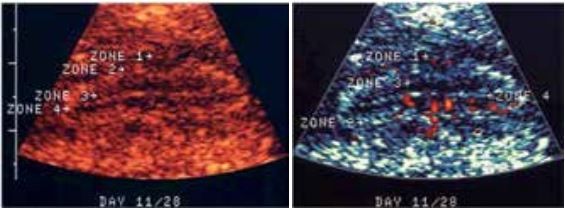
चित्र 2:इस एंडोवैजिनल इमेज में सामान्य ज़ोन 3 में ब्लड फ्लो दिखाई दे रहा है।
एम्ब्रियो ट्रांसफ़र का दिन:एम्ब्रियो ट्रांसफ़र एम्ब्रियो के दूसरे दिन, तीसरे दिन या पाँचवें दिन किया जा सकता है। पाँचवें दिन का एम्ब्रियो (ब्लास्टोसिस्ट) ट्रांसफ़र बेहतर माना जाता है, क्योंकि इससे बेहतर एम्ब्रियो का चयन किया जा सकता है, जिससे सफलता दर अधिक होती है।
यह तकनीक:अल्ट्रासाउंड की मदद से गर्भाशय ग्रीवा और गर्भाशय को देखने के लिए मूत्राशय को थोड़ा भरा होना चाहिए। भ्रूणों को कुछ माध्यम के साथ एक भ्रूण स्थानांतरण कैथेटर में डाला जाता है। बाहरी कैथेटर को अल्ट्रासाउंड की मदद से गर्भाशय के अंदरूनी भाग तक पहुंचाया जाता है। इसके बाद, भरे हुए आंतरिक कैथेटर को गर्भाशय के फंडस से 1-2 सेंटीमीटर नीचे तक पहुंचाया जाता है। आंतरिक कैथेटर पर लगे प्लंजर को इस तरह से धकेला जाता है कि भ्रूणों वाला बुलबुला गर्भाशय की ऊपरी दीवार (फंडस) से 1.5 सेंटीमीटर नीचे दिखाई दे। यह अधिकतम आरोपण के लिए सही स्थिति है। यदि इसे बहुत आगे धकेला जाता है, तो ट्यूब में एक्टोपिक गर्भावस्था होने की संभावना बढ़ सकती है। यदि इसे बहुत नीचे धकेला जाता है, तो भ्रूण बाहर निकल सकता है।
कैथेटर का प्रकार:एम्ब्रियो ट्रांसप्लांट के लिए एक नरम कैथेटर का उपयोग किया जाना चाहिए, क्योंकि इससे कम से कम नुकसान होता है जब इसे डाला जाता है, जिससे एंडोमेट्रियम में कोई गड़बड़ी नहीं होती है और गर्भाशय के संकुचन को बढ़ावा नहीं मिलता है, जिससे एम्ब्रियो बाहर निकल सकता है।
क्लीनिशियन और एम्ब्रायोलॉजिस्ट का अनुभव:इस प्रक्रिया की सफलता कई कारकों पर निर्भर करती है, जो बदले में टीम के अनुभव पर निर्भर करते हैं। कैथेटर लोड करने और एम्ब्रियो ट्रांसफर करने में कम से कम समय लगना चाहिए।
एम्ब्रियो ट्रांसफ़र के बाद: एम्ब्रियो ट्रांसफ़र के बाद महिला को थोड़ी देर आराम करने के लिए कहा जाता है। हालांकि, इसके बाद वह अपनी सामान्य गतिविधियाँ जारी रख सकती है।9
ट्रांसफर किए जाने वाले भ्रूणों की संख्या: आमतौर पर दो ब्लास्टोसिस्ट ट्रांसफर किए जाते हैं। 40 वर्ष से अधिक उम्र के लोगों में, खासकर उन लोगों में जिनमें पहले आईवीएफ चक्र विफल रहे हैं, सफल आरोपण की दर कम होती है; इसलिए, इन मामलों में अक्सर अधिक भ्रूण (जैसे, अधिकतम तीन) ट्रांसफर किए जाते हैं। हालांकि, कम उम्र की महिलाओं या उन महिलाओं में जो कम उम्र की डोनर से अंडे का उपयोग कर रही हैं, आरोपण की दर कम उम्र के लोगों के समान होती है, और आमतौर पर उन्हें एक या दो से अधिक भ्रूण ट्रांसफर करने की सलाह नहीं दी जाती है।10
7. Freezing of excess embryos
Embryos that are not transferred may be stored by freezing them in liquid nitrogen. The chances of a successful pregnancy are similar for frozen and fresh embryos. They can be stored for a period of 10 years.
Adverse effects of IVF
FSH injections can have side effects like enlarged ovaries, nausea and bloating. It is an invasive procedure. The cycle can fail to yield a pregnancy. There can be multiple pregnancies if more than one embryo is transferred. Serious complications of egg retrieval are uncommon, but side effects such as pelvic cramping, light bleeding, and vaginal discharge often occur.
Ovarian hyperstimulation syndrome (OHSS) is a condition in which the side effects of ovarian enlargement and abdominal swelling become extreme. This can cause severe abdominal pain, vomiting, and if untreated, blood clots in the legs or lungs and fluid imbalances in the blood. Mild forms of OHSS occur in 2 to 6 percent of people undergoing ovulation induction for IVF. Severe cases of OHSS occur in approximately less than 1 percent of cases, typically in association with the retrieval of more than 20 eggs. Currently it is extremely rare as risk of OHSS becomes negligible by utilizing a GnRH agonist instead of hCG as ovulation trigger, avoiding fresh embryo transfer, or by cancelling the IVF cycle when blood oestrogen levels become too high or there are too many follicles seen on ultrasound. In preventing hyper response besides these clinical actions it is important to identify a hyper responder to ensure they get lower dose of FSH.11
Identifying a hyper responder: The prevalence of a hyper responder is 7% on the average and is more with younger patients than older. Not only is prediction of a high response prior to stimulation useful in counselling patients on the risk of ovarian hyperstimulation syndrome (OHSS) but also gives a real possibility of modifying the stimulation protocol and reduce the incidence of a high response and OHSS.
Identification of factors before stimulation predicting hyper response (Table 2)
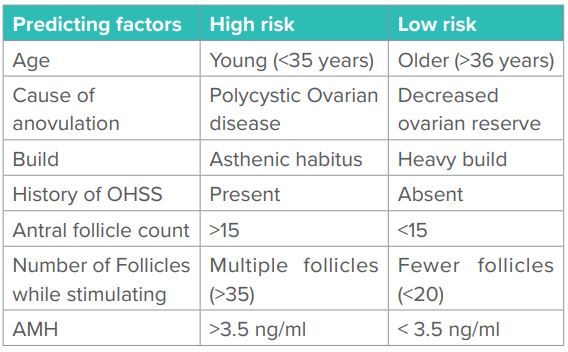
Table 2: Risk factors for hyperstimulation
Its pathophysiology is primarily dependent upon hCG trigger which acts through various vasoactive mediators to increase capillary permeability in blood vessels. Primary prevention is most desirable and includes recommended measures like reduction of gondaotropin dose, GnRHa as ovulation trigger and metformin use. OHSS management depends on its symptoms, severity, complications and presence or absence of pregnancy. Mild to moderate OHSS can usually be treated on an outpatient basis with oral analgesics and maintaining fluid balance. Severe OHSS usually warrants hospital admission and requires aggressive medical management. Surgical treatment may be required in patients with ovarian accidents like torsion or ectopic pregnancies. Improved understanding of pathophysiology and risk factors along with recent advances in ovulation induction methods permit considerable reduction in incidence, morbidity and mortality of OHSS.
Special interventions
Assisted reproductive technologies have progressed over the last 40 years to give optimum success rates and options. Many specialized interventions have changed previous protocols.
I. Blastocyst culture: Embryos can be grown and transferred on day 3 but now extended culture to day 5 known as blastocyst culture is the norm as there are media which help embryo to grow to Day 5. A blastocyst has a higher chance of implantation and pregnancy than day 3 embryo
II. Single embryo transfer: Single embryo transfer to avoid multiple pregnancy is being offered as an option keeping in mind that twin pregnancy is a high-risk pregnancy.
III. Laser hatching: Hatching is a process where the laser makes a hole in the outer covering of the embryo allowing it to hatch and implant once it is transferred in the uterus. It is done just before the transfer. It is recommended in older women, frozen embryos or those with recurrent IVF failures with the idea of facilitating implantation.
IV. Therapies for thin endometrium: Persistently thin endometrium is being now investigated as a microbiome problem and treatment for the same if detected. Platelet rich plasma (PRP), Granulocyte colony stimulating factor (GCSF) and stem cells are still evolving techniques of rejuvenative medicine for this condition.12
V. Preimplantation genetic testing (PGT): Preimplantation genetic testing (PGT) may be performed for 3 indications – Firstly to determine the number of chromosomes (PGT-A) detect trisomy or monosomy (aneuploidy), secondly for ruling out a specific disease or gene abnormality (PGT-M) eg cystic fibrosis or sickle cell anaemia which may be present in parents or siblings, and thirdly to test for abnormal chromosome structure (PGT-SR) which can lead to recurrent abortions. In PGT-M Patients may choose to have their embryos tested prior to transfer to discard embryos which have the disease or genetic mutation, and transfer only those which are normal. The embryos are tested on day 5 in blastocyst stage by removing a few cells from embryo and sending for analysis.5
VI. Embryo pooling for low egg reserve: Very often women undergo an IVF have a poor ovarian reserve where only one or two eggs are retrieved. In these cases, embryo pooling is suggested for better results. Egg retrieval is done 2 or 3 times, fertilized and embryos are frozen. The embryos are then pooled so that a better selection is available and more than one can be transferred for a higher success rate. The cumulative pregnancy rate was statistically higher in this group (41.5%) than the conventional IVF group (22.3%).9 Embryo pooling is now a well established procedure being done where response is poor leading to less embryos.13
VII. Autologous stem cell ovarian transplant (ascot) and platelet rich plasma (PRP): Stem cell transplant and PRP instillation in ovaries with the idea of regenerating the follicle pool in poor ovarian reserve women is still experimental.14,15 Some studies showed that the ASCOT improved follicle and oocyte quantity enabling pregnancy in women who are poor responders previously limited to oocyte donation.
VIII. Testicular sperm retrieval: Before the IVF procedure males should be encouraged to lose weight, stop smoking and eat healthy. They should be put on antioxidants as deficiency has been known to cause DNA damage in sperms and poor sperm morphology and motility. Hormones may be replaced if deficiency is found. Testicular sperm is required if sperms are absent This can be done by needle aspiration or a testicular biopsy i.e. taking a piece of testis and milking it out for sperms. An advanced treatment is Microtese where the testis is opened under the microscope and small tubules which are dilated and more likely to have sperms identified and removed. This is important as only very minimal testicular tissue is removed unlike in open biopsy where the pieces removed are bigger. This technique is only done in advanced centres. Success rates seen are 38% and successful fertilization, clinical pregnancy, and live birth were observed in 85.4%, 22.3%, and 10.7% couples, respectively.16
Success rates
IVF has a reasonable rate of success in most cases. Overall, 50 to 55% patients have a positive beta hCG on testing. Approximately 35-40 percent of IVF cycles will end in a live birth, and the cumulative chances of success are higher when more than one cycle of IVF is done.
However, an individual’s chance of success depends on several factors, including age, cause of infertility, and treatment approach. For example, in the United States in 2021, the live birth rate for each IVF cycle started was approximately 45 percent for people under age 35 years; 32 percent for people ages 35 to 37; 21 percent for people ages 38 to 40; 10 percent for people ages 41 to 42; and 3 percent for people over age 42. The success rates of individual infertility clinics in the United States are published on the internet at the Society for Assisted Reproductive Technology.17
IVF is an expensive procedure, and it causes a significant economic burden. The cost is because it requires stringent quality control, only specific media which have had animal testing for no toxicity, and precise instrumentation. It also requires highly skilled manpower to make it a successful program. Any IVF centre which compromises on quality gives poor results. To maintain certain quality and standards a cost is incurred which is translated into an IVF cycle. These are costs are inbuilt into the system and cannot be separated.
Today, IVF is an acceptable procedure with a high success rate. It is now more easily accessible with wider indication as with time its advantages have been given credit.
References
- WHO https://www.who.int/publications/i/item/9789240030787.
- Katsani D, Paraschou N, Panagouli E, Tsarna E, Sergentanis TN, Vlahos N et al. Social Egg Freezing—A Trend or Modern Reality?. Journal of Clinical Medicine. 2024 Jan 10;13(2):390.
- Sienko A, Prakash A, MacDougall J. Oocyte cryopreservation in mosaic Turner syndrome with polycystic ovaries. F&S Reports. 2023 Dec 1;4(4):380-3.
- Demeestere I, Simon P, Dedeken L, Moffa F, Tsépélidis S, Brachet C et al. Live birth after autograft of ovarian tissue cryopreserved during childhood. Human reproduction. 2015 Sep 1;30(9):2107-9.
- Sordia-Hernandez LH, Morales-Martinez FA, González-Colmenero FD, Flores-Rodriguez A, Leyva-Camacho PC, Sordia-Piñeyro MO et al. The Effects of Preimplantation Genetic Testing for Aneuploidy (PGT-A) on Patient-Important Outcomes in Embryo Transfer Cases: A Meta-Analysis. Journal of Reproduction & Infertility. 2022 Oct;23(4):231.
- Gigstad K, Li Y, Thaler J, Irwin R. HIV and access to fertility treatment in the European and Swedish contexts. Sexual & Reproductive Healthcare. 2023 Mar 1;35:100812.
- Farsimadan M, Riahi SM, Muhammad HM, Emamvirdizadeh A, Tabasi M, Motamedifar M, Roviello G. The effects of hepatitis B virus infection on natural and IVF pregnancy: A meta-analysis study. Journal of Viral Hepatitis. 2021 Sep;28(9):1234-45.
- Ghumman S, Saxena P, Patel S, Gupta S, Gupta M. Impact of BMI on IVF outcome. Fertility Science and Research. 2018 Jan 1;5(1):14-7.
- Cozzolino M, Troiano G, Esencan E. Bed rest after an embryo transfer: a systematic review and meta-analysis. Archives of Gynecology and Obstetrics. 2019 Nov;300:1121-30.
- ASRM Maximum Number of Embryos to be Transferred in Assisted Reproductive Technologies cycle: Ethics Opinion. J Hum Reprod Sci. 2018 Apr-Jun;11(2):93-95.
- Mordel N, Schenker JG. Gonadotrophin-releasing hormone agonist and ovarian hyperstimulation syndrome in assisted reproduction. Human Reproduction. 1993 Dec 1;8(12):2009-14.
- Zadehmodarres S, Salehpour S, Saharkhiz N, Nazari L. Treatment of thin endometrium with autologous platelet-rich plasma: a pilot study. JBRA assisted reproduction. 2017 Jan;21(1):54.
- Gandhi G, Allahbadia G, Kagalwala S, Allahbadia A, Ramesh S, Patel K, Hinduja R, Chipkar V, Madne M, Ramani R. ACCU-VIT: a new strategy for managing poor responders. Hum Reprod. 2013 Jun 1;28:i149-206.
- Hajipour H, Farzadi L, Latifi Z, Keyhanvar N, Navali N, Fattahi A et al. An update on platelet-rich plasma (PRP) therapy in endometrium and ovary related infertilities: clinical and molecular aspects. Systems biology in reproductive medicine. 2021 May 4;67(3):177-88.
- Herraiz S, Romeu M, Buigues A, Martínez S, Díaz-García C, Gómez-Seguí I, Martínez J, Pellicer N, Pellicer A. Autologous stem cell ovarian transplantation to increase reproductive potential in patients who are poor responders. Fertility and sterility. 2018 Aug 1;110(3):496-505.
- Vahidi S, Horoki AZ, Talkhooncheh MH, Jambarsang S, Marvast LD, Sadeghi A, Eskandarian S. Success rate and ART outcome of microsurgical sperm extraction in non obstructive azoospermia: A retrospective study. Int J Reprod Biomed. 2021 Oct 10;19(9):781-788.
- SARThttps://sartcorsonline.com/Csr/Public?ClinicPKID=0&re portingYear=2021&newReport=True#patient-cumulative.