 WhatsApp Us (24/7)
 +91 926 888 0303 (24/7)


To Book an Appointment
Call Us+91 926 888 0303Robotic GI Surgery: Benefits, Types, & Advantages
By Dr. Ajay Yadav in Gastrointestinal & Hepatobiliary Oncology , Gastrointestinal Surgery , Gastro Intestinal & Hepatopancreatobiliary Surgical Oncology , Robotic Surgery
Aug 25 , 2025 | 2 min read

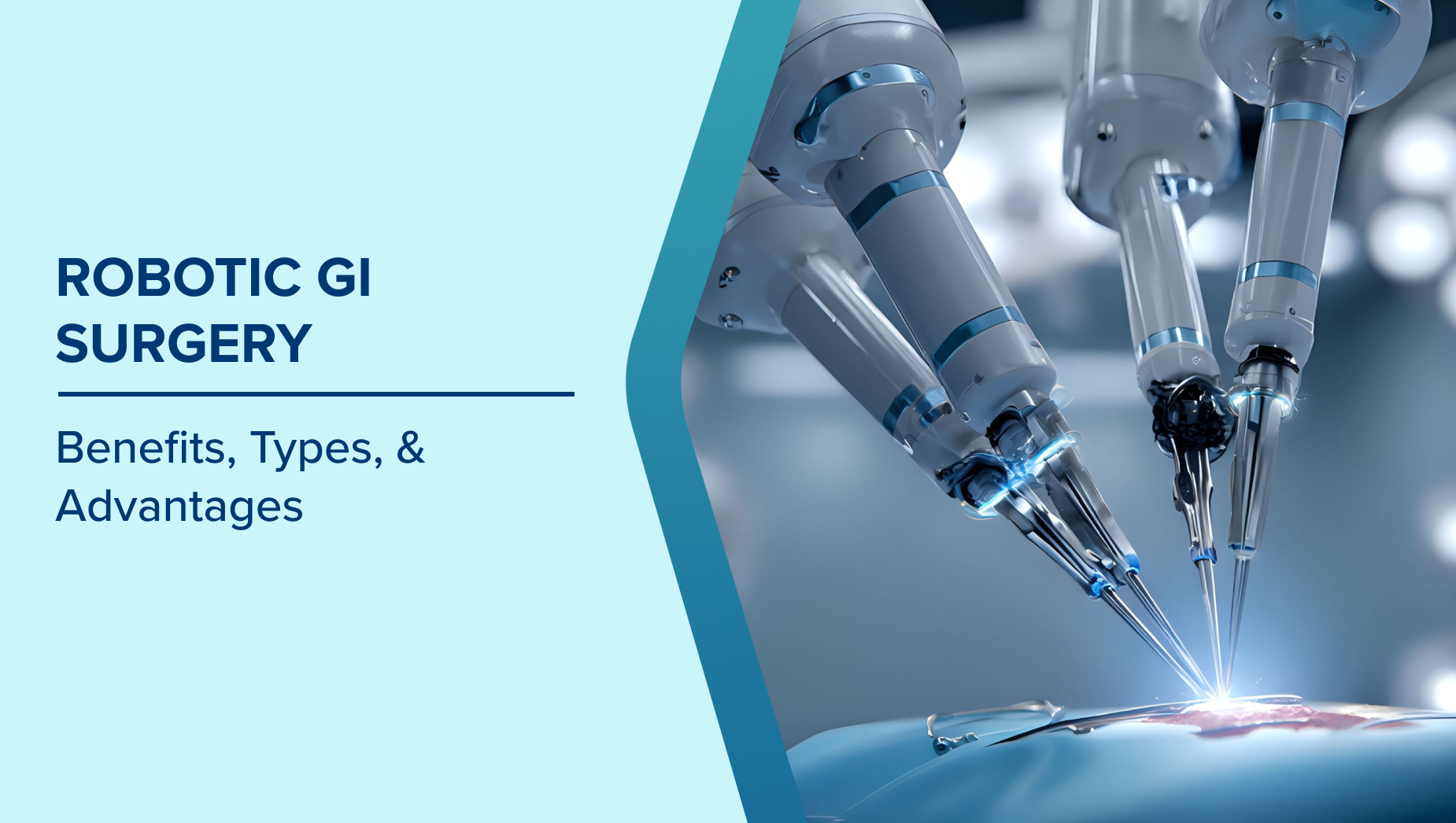
Robotic surgery is a modern-day medical revolution that offers significant benefits for both patients and doctors. When it comes to gastrointestinal (GI) surgeries, robotic systems have transformed the way procedures are performed by enhancing surgical precision and adopting a minimally invasive approach.
GI robotic surgery is often described as surgery with more precision and care, delivering dual benefits to both patients and surgeons.
Advantages of Robotic GI Surgery for Doctors
Robotic GI surgery equips surgeons with advanced tools that improve surgical performance and outcomes. Key advantages include:
- Minimally invasive approach that lowers the risk of complications.
- Enhanced vision and precision with a 3D high-definition view.
- Greater mobility and flexibility, as robotic arms can rotate 360 degrees.
- Improved control during complex GI surgeries.
These features allow doctors to perform delicate procedures with higher accuracy, ultimately leading to safer and more effective treatments.
Benefits of Robotic GI Surgery for Patients
For patients, robotic GI surgery ensures faster recovery and fewer complications compared to traditional methods. Some major benefits include:
- Quicker recovery time and shorter hospital stays.
- Minimal scars with improved cosmetic outcomes.
- Reduced risk of infections.
- Better long-term surgical results.
By minimising trauma to the body, robotic GI surgery helps patients return to normal life much sooner.
Types of Robotic GI Surgeries
Robotic systems are increasingly being used for a wide range of gastrointestinal procedures. Some notable examples include:
- Whipple surgery: Performed with robotic assistance to treat conditions affecting the pancreas.
- Robotic polypectomy: Used to remove polyps from the colorectal region, where traditional laparoscopy or endoscopy may not deliver the best results.
- Robotic gallbladder and hernia surgeries: Offering improved precision and faster recovery.
- Robotic cholecystectomy: A gallbladder removal procedure that also includes a newer technique known as Bikini Line Robotic Surgery, where scars are hidden below the waistline for improved cosmetic results.
These procedures highlight how robotic technology is being used to expand the possibilities of GI surgeries.
Robotic GI Surgery at Max Hospital, Lucknow
At Max Hospital, Lucknow, robotic GI surgeries are performed using the advanced Da Vinci Xi robot, one of the most sophisticated robotic systems available today. This technology provides surgeons with unmatched precision, flexibility, and control during operations, setting a new benchmark for surgical care.
By combining advanced technology with medical expertise, Max Hospital ensures that patients receive world-class treatment with minimal complications and better outcomes.
Conclusion
Robotic GI surgery represents the future of surgical care, offering precision, safety, and faster recovery. With benefits that support both doctors and patients, robotic systems are quickly becoming the preferred method for complex GI procedures. At Max Hospital, Lucknow, the use of the Da Vinci Xi robot showcases how advanced technology can transform treatment and improve patient outcomes, all while prioritising precision and care.
Written and Verified by:

Related Blogs

Dr. Debashish Chaudhary In Surgical Oncology , Cancer Care / Oncology , Gastrointestinal & Hepatobiliary Oncology
Dec 21 , 2023 | 7 min read

Blogs by Doctor

Most read Blogs


Related Blogs
Dr. Debashish Chaudhary In Surgical Oncology , Cancer Care / Oncology , Gastrointestinal & Hepatobiliary Oncology
Dec 21 , 2023 | 7 min read
Blogs by Doctor
Most read Blogs