 WhatsApp Us (24/7)
 +91 926 888 0303 (24/7)


Abstract:
In healthcare administration, leadership is essential because it affects personnel morale, organisational performance, and care quality. This study of the literature examines the many leadership philosophies that are common in hospital environments and how they affect organisational outcomes. Based on regional and international research, the review emphasises the effects of transformational, transactional, servant, and autocratic leadership styles on performance metrics like financial management, innovation, staff happiness, and the quality of patient care. According to the review's findings, high organisational performance in hospitals is most favourably correlated with transformational and servant leadership.
Key words: : Hospital Administration, Leadership Styles, Organisational Performance, Transformational Leadership, Healthcare Management.
Introduction
In hospital management, strong leadership is essential to ensure the efficient, moral, and patient-centred delivery of healthcare services.1 Today's hospitals must contend with several issues, such as growing patient volumes, staff shortage, regulatory requirements, and the complexity of healthcare technology. In this situation, hospital organisations' ability to function effectively under these challenges is significantly influenced by their leadership style.2 Patient results, staff morale, and the long-term viability of a business are all impacted by a leader's capacity to engage his or her team, foster trust, communicate effectively, and adjust strategically.3
In the healthcare industry, leadership is about impact and teamwork, not just power. Team dynamics, clinical practice adoption, and motivation and retention of healthcare professionals are all impacted by leadership styles in hospital settings.4 To improve healthcare systems, the World Health Organisation (WHO) and other international health organisations have highlighted leadership development as a top goal. For health managers, politicians, and practitioners alike, it is crucial to comprehend which leadership philosophies yield the best outcomes.5
In the literature on healthcare, several leadership ideas are prevalent. Often praised for its inspiring and visionary traits, transformational leadership fosters innovation and ongoing learning among employees. Research has indicated a positive correlation between this style and improved patient safety, lower burnout, increased organisational agility, and staff satisfaction.6,7 On the other hand, transactional leadership has been linked to increased efficiency but decreased engagement and innovation, as it emphasises job completion through reward-based incentives and set policies.8
These leadership philosophies are not exclusive, and depending on the situation, actual hospital administrators may display characteristics from several philosophies. However, existing research indicates that certain approaches are better suited to encourage innovation, employee retention, and high-quality care.
The importance of emotionally aware and adaptable leadership in handling the complexity of contemporary hospitals is becoming increasingly apparent.
To give readers a comprehensive understanding of how various leadership philosophies affect organisational performance in hospital settings, this review synthesises the body of available empirical and theoretical material.
The evaluation provides insights that help guide hospital administration training, policy, and strategic planning by identifying effective leadership approaches.
Aim and ObjectivesAim: To review existing literature on leadership styles in hospital administration and their impact on organisational performance.
Objectives:- To identify and describe common leadership styles employed in hospital settings.
- To evaluate the impact of each leadership style on organisational performance indicators.
- To highlight the most effective leadership approaches based on empirical evidence.
A narrative literature review methodology was adopted. Articles published between 2010 and 2024 were sourced from databases including PubMed, Scopus, Web of Science, and Google Scholar. Keywords used for the search included "leadership styles," "hospital administration," "organisational performance," and "healthcare leadership."
Inclusion Criteria:- Peer-reviewed journal articles
- English language
- Studies focused on hospital or healthcare settings
- Non-peer-reviewed articles
- Editorials or opinion pieces without empirical data
A total of 45 articles were selected based on relevance and quality of evidence. The data was synthesised thematically, and key findings were summarised in tables and figures.
ResultsThe review identified four predominant leadership styles in hospital administration transformational, transactional, servant, and autocratic. Their effects on various performance metrics are summarised below (Table 1).
Centralised decision-making, which is a hallmark of autocratic leadership, has proven useful in emergency or time-sensitive scenarios where prompt, decisive action is crucial. Despite this, it is often associated with low employee morale, a lack of innovation, and a greater incidence of turnover, making it less suitable for collaborative healthcare settings.
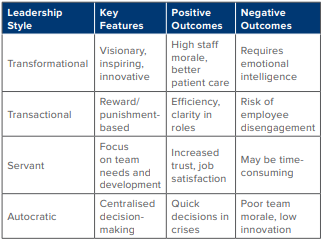
Table 1: Summary of leadership styles and organisational outcomes.
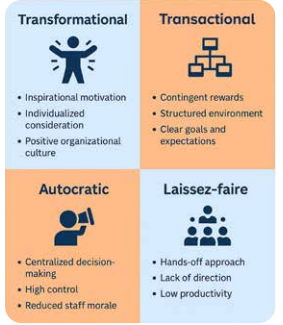
Figure 1: : Impact of leadership styles on hospital performance indicators.
The analysis found that hospital administration frequently employs four main leadership concepts—transformational, transactional, servant, and autocratic (Figure 1). Each of these philosophies has a unique effect on healthcare outcomes and organisational performance
Across several performance metrics, transformational leadership was found to be the most advantageous. This type of leader is distinguished by their inspiring and imaginative attitude, which frequently stimulates creativity and cultivates a sense of unity among employees. According to several studies, transformational leaders greatly increased healthcare systems' capacity for adaptation, patient satisfaction, and workforce engagement. Its efficacy, however, often depends on the leader's interpersonal and emotional intelligence.
Increased trust, employee loyalty, and a positive work environment have all been linked to servant leadership, which emphasises attending to employees' needs and fostering their professional development. Although it could take more time and work to implement effectively in hectic hospital environments, this approach promotes teamwork and long-term staff development.
Structured incentive and accountability systems underpin transactional leadership, which fosters role clarity and operational effectiveness. It is effective in maintaining order and following protocol. However, it often lacks the adaptability and creativity required in fast-paced healthcare settings, and if applied too strictly or excessively, it may lower motivation
Servant leadership is another increasingly popular structure that emphasises employee empowerment, trust-building, and prioritising team members’ welfare. Despite being more prevalent in community or non-profit settings historically, servant leadership has drawn interest in hospital administration due to its association with enhanced team cohesion, ethical climate, and communication.9 On the other hand, authoritarian leadership, which is typified by tight control and centralised decision-making, can occasionally be effective in emergencies, but frequently lowers morale and inhibits innovative problem-solving.10
Conclusion
In hospital administration, leadership is more than just a managerial role; it is a strategic tool that affects every facet of organisational performance, from financial results to patient care. Transformational, transactional, servant, and autocratic are the four main leadership philosophies that have been studied in this literature review, along with how they affect important performance metrics in hospital environments.
When it comes to encouraging innovation, patient safety, and employee satisfaction, transformational leadership has continuously been the most successful of these. Its emphasis on motivation, personalised support, and a shared vision aligns well with the intricate, multidisciplinary nature of medical settings. Servant leadership also holds great promise, especially in developing moral corporate cultures and boosting employee confidence. By empowering and engaging frontline staff, these approaches promote sustainable improvements in patient care and healthcare delivery.
However, transactional leadership may not adequately inspire healthcare teams or promote long-term development, even though it is advantageous in preserving operational structure and accountability. Autocratic leadership is generally linked to lower morale and reduced flexibility, even if it may be appropriate in some high-pressure situations or emergencies.
The main conclusion drawn from the literature is that healthcare leadership must be adaptable, emotionally intelligent, and responsive to context. Hospital executives are best positioned to attain high organisational performance if they can combine elements of servant and transformational leadership, while also utilising transactional tools when necessary. Hospital systems should place a high priority on communication, strategic thinking, emotional intelligence, and ethical decision-making in their leadership development programmes.
Future research should also examine hybrid leadership models and assess how organisational, demographic, and cultural factors affect the effectiveness of leaders. Leaders in the ever-changing healthcare industry must be mentors, innovators, and advocates for both employees and patients in addition to being administrators.
In summary, implementing and developing effective leadership styles in hospital administration is not only advantageous but also necessary for providing high-quality healthcare in a way that is efficient, equitable, and sustainable.
Bhagyashree S, Ayuj Kaushik. Leadership Styles in Hospital Administration and Their Impact on
Organisational Performance: A Literature Review. MMJ. 2025. June. Vol 2 (2).
References
- Daly J, Jackson D, Mannix J, et al. The importance of clinical leadership in the hospital setting. J Healthc Leadersh. 2014;6:75–83.
- Giltinane CL. Leadership styles and theories. Nurs Stand. 2013;27(41):35–39.
- Rosenman ED, Shandro JR, Ilgen JS, et al. Leadership training in health care action teams: A systematic review. Acad Med. 2014;89(9):1295–1306.
- Jooste K. Leadership in health services management. Cape Town: Juta and Company Ltd; 2009.
- Avolio BJ, Walumbwa FO, Weber TJ. Leadership: Current theories, research, and future directions. Annu Rev Psychol. 2009;60:421–449.
- Al-Sawai A. Leadership of healthcare professionals: Where do we stand? Oman Med J. 2013;28(4):285–287.
- Cummings GG, Tate K, Lee S, et al. Leadership styles and outcome patterns for the nursing workforce and work environment: A systematic review. Int J Nurs Stud. 2018;85:19–60.
- Eva N, Robin M, Sendjaya S, et al. Servant leadership: A systematic review and call for future research. Leadersh Q. 2019;30(1):111–132.
- Bass BM. Two decades of research and development in transformational leadership. Eur J Work Organ Psychol. 1999;8(1):9–32.
- Salanova M, Lorente L, Chambel MJ, et al. Linking transformational leadership to nurses' extra-role performance: The mediating role of self-efficacy and work engagement. J Adv Nurs. 2011;67(10):2256–2266.
- Wong CA, Cummings GG. Authentic leadership: A new theory for nursing or back to basics? J Health Organ Manag. 2009;23(5):522–538.
- Northouse PG. Leadership: Theory and practice. 8th ed. Thousand Oaks: Sage Publications; 2018.