 WhatsApp Us (24/7)
 +91 926 888 0303 (24/7)


Abstract:
Primary hyperaldosteronism (PHA), also known as Conn’s syndrome, accounts for 5%-10% of hypertensive cases. It is a condition caused by an adrenal tumour that produces excess aldosterone. This hormonal excess leads to high blood pressure and is referred to as Conn’s syndrome, named after the doctor who first described it. Although, symptoms may be mild, prolonged exposure to high aldosterone levels is very toxic, and can cause stroke and heart attacks. This report presents a patient who came with paralytic symptoms due to severe hypokalaemia. On investigation, he was diagnosed with a Conn’s adenoma, which was subsequently treated by adrenalectomy. This is a rare presentation of Conn’s adenoma and was managed in a timely manner through a multidisciplinary approach. Robotic-assisted surgery benefited the patient by enabling a rapid recovery with minimal blood loss. The patient’s blood pressure normalised following the adrenalectomy.
Key words: Primary Hyperaldosteronism, Conn’s Syndrome, Conn’s Adenoma, Hypokalaemic Paralysis, RobotAssisted Laparoscopic Adrenalectomy.
Introduction
Primary hyperaldosteronism (PHA) is a condition caused by an adrenal tumour that produces excess amounts of the hormone aldosterone. PHA, also known as Conn’s syndrome, accounts for 5%-10% of hypertensive cases.1 While the majority of hypertensive patients with PHA are normokalaemic, around half of those with aldosterone-producing adrenal adenomas are hypokalaemic.2
This report presents a case of hypokalaemic paralysis as the presenting symptom in a patient with an aldosteroneproducing adrenal adenoma. The initial symptoms were suggestive of a neurological event leading to paralysis, but subsequent investigations revealed hypokalaemia induced by hyperaldosteronism. This paper highlights this rare presentation of hypokalaemic paralysis due to Conn’s adenoma and the advantages of robotic-assisted surgery in the management of such tumours.
Case report
A 30-year-old gentleman presented with left lower limb weakness and stiffness lasting 24 hours. He experienced difficulty in weight bearing and walking and reported muscle cramps in both lower limbs over the preceding two days. He was hypertensive (blood pressure: 180/100 mmHg) and was taking telmisartan 40 mg, ramipril 2.5 mg, and hydrochlorothiazide 12.5 mg once daily.
He was conscious and oriented, and on clinical examination found to have left lower limb weakness. On biochemical evaluation, his sodium was 144 mEq/L and serum potassium was 1.55 mEq/L. His creatine phosphokinase (CPK) was elevated at 5909 U/L, and urine spot potassium was 7.88 mmol/L. Urine pH was alkaline, and arterial blood gas analysis showed alkalosis.
Ultrasound (USG) of the whole abdomen revealed a 3-4 cm mass in the left adrenal gland. His serum aldosterone level was elevated at 26 ng/dL and direct renin concentration was 0.5 ng/dL, giving an aldosterone-renin ratio of 503. Co-secretion of cortisol and dehydroepiandrosterone sulphate (DHEAS) was ruled out by doing overnight dexamethasone suppression tests and DHEAS levels.
He was diagnosed as a case of PHA. A 5-fluorodeoxyglucose positron emission tomography-computed tomography (5-FDG PET-CT) scan revealed a 3-4 cm well defined, minimally peripherally enhancing FDG-avid mass in the left adrenal region, suggestive of a functional adrenal adenoma (Figure 1a and b).
The endocrinologist team managed him with intravenous (IV) potassium and spironolactone. His limb weakness recovered on the same day, and he was planned for a left robotic-assisted adrenalectomy. The Da Vinci Xi robotic system (Intuitive Surgical, USA) was used. The adrenalectomy was performed without any challenges, as the plane around the adrenal was well preserved (Figure 1c and d). He recovered well, with stable serum potassium levels and blood pressure postoperatively.
Anti-hypertensive medications were discontinued on the postoperative day two, and the patient was discharged the same day. Histopathology was consistent with the diagnosis of an adrenal adenoma. His blood pressure gradually normalised, and his antihypertensive medications were discontinued.
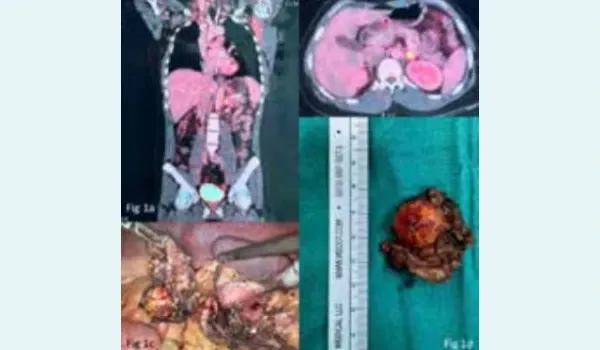
Figure 1: (a) sagittal section, (b) transverse section of 5-fluorodeoxyglucose positron emission tomography-computed tomography (5-FDG PET-CT) scan showing FDG-avid lesion in left adrenal gland, (c) intraoperative image, (d) image of the excised tumour.
Discussion
This case highlights an unusual presentation of Conn's adenoma or PHA with severe hypokalaemia manifesting as acute lower limb weakness. Excess aldosterone can lead to hypokalaemic rhabdomyolysis, and metabolic alkalosis.1 A suppressed renin level and elevated aldosterone-to-renin ratio confirmed the diagnosis of PHA,2 while USG and CT scan detected a functional adrenal adenoma.3 The patient was stabilised preoperatively with IV potassium and spironolactone.4 Robotic-assisted adrenalectomy, using the Da Vinci Xi system, enabled precise dissection and successful removal of the functional adrenal adenoma, with minimal blood loss and rapid recovery.5,6 Postoperatively, the patient experienced resolution of hypokalaemia, limb weakness, and hypertension, enabling discontinuation of antihypertensive medications.
Hypokalaemic periodic paralysis is a rare disorder with an estimated prevalence of 1 in 100,000. It is characterised by transient attacks of flaccid paralysis of varying intensity and duration, which, if not recognised in time, has the potential to be life-threatening.7 In this case, the patient presented with suddenonset flaccid quadriparesis. On clinical examination, his blood pressure was 180/100 mmHg, and laboratory tests revealed hypokalaemia and metabolic alkalosis. He was initially managed with potassium supplementation and antihypertensives. His weakness completely improved within 12 hrs. Based on the clinical triad of hypertension, hypokalaemia, and metabolic alkalosis, a presumptive diagnosis of PHA was made. Screening with plasma aldosterone and plasma rennin activity confirmed a high aldosterone-to-renin ratio.
PHA or Conn’s syndrome is characterised by suppressed plasma renin activity, elevated and non-suppressible plasma aldosterone and hypokalaemia.8 Its presentation is highly variable and typically occurs in patients who are in the third to sixth decade of life. Hypertension is often the sole presenting feature and may be refractory to treatment. Interestingly, hypokalaemia is less common in PHA than previously thought. Kuo et al.9 found that plasma potassium levels were <3.3 mEq/L in only 18% of confirmed PHA cases.
While hypokalaemic periodic paralysis may result from thyrotoxicosis and Conn’s syndrome, it is rarely reported as a presenting manifestation of Conn’s syndrome and is rarely reported in the literature. Although hypokalaemia often responds well to surgical treatment, some patients may continue to require antihypertensive therapy, albeit at lower doses postoperatively. Persistent hypertension after adrenalectomy has been associated with older age, elevated serum creatinine, use of multiple antihypertensive agents preoperatively, and longer duration of hypertension.10
In the present case, the patient’s blood pressure and potassium levels normalised, and metabolic alkalosis resolved on the evening of surgery. This case is a rare example of Conn’s adenoma presenting with hypokalaemic periodic paralysis, which responded well to robotic adrenalectomy.
Declarations
- Ethics approval and consent to participate: Not applicable.
- Ethics declaration: Not applicable.
- Consent for publication: Not applicable.
- Consent to participate declaration: Not applicable.
- Availability of data and materials: Not applicable.
- Competing interests:The authors declare no competing interests.
- Funding:This research received no external funding
- Author contribution declaration:V.V. and P.T. diagnosed and managed the patient's electrolyte and endocrine abnormalities pre and post op. S.C.S, P.K and A.J. performed the robotic-assisted laparoscopic left adrenalectomy. S.C.S. and S.N.P. drafted the main manuscript and prepared Figure 1 (a, b, c and d). All authors reviewed and approved the final manuscript.
Conclusion
Although PHA due to Conn’s adenoma is a rare cause of hypokalaemic paralysis, it should be considered in the differential diagnosis. Robotic-assisted adrenalectomy is a novel, effective, and minimally invasive approach to excise such tumours, offering improved ergonomics and favourable outcomes.
Shailesh Chandra Sahay, Pawan Kesarwani, Varun Verma, Priyamvada Tyagi, Abhijeet Jha,
Shubhankar Powar. Robotic-Assisted Adrenalectomy: A Novel Approach to Manage Conn’s
Adenoma. MMJ. 2025, June. Vol 2 (2).
References
- Goto A, Takahashi Y, Kishimoto M, et al. Primary aldosteronism associated with severe rhabdomyolysis due to profound hypokalemia. Intern Med. 2009;48[4]:219-23.
- Funder JW, Carey RM, Mantero F, et al. The Management of Primary Aldosteronism: Case Detection, Diagnosis, and Treatment: An Endocrine Society Clinical Practice Guideline. J Clin Endocrinol Metab. 2016;101(5):1889-916.
- Sundin A. Adrenal Molecular Imaging. Front Horm Res. 2016;45:70-9.
- Amar L, Lorthioir A, Azizi M, et al. Progress in primary aldosteronism. Mineralocorticoid antagonist treatment for aldosterone-producing adenoma. Eur J Endocrinol. 2015;172(3):R125-9.
- Becker B, Rosenbaum CM. Current Milestones and Future Horizons in Minimally Invasive Urologic Surgery. J Clin Med. 2024;13(21):6573.
- Maharajh SK, Ashoush F, Ramsingh JK. Surgical outcomes from robotic-assisted adrenalectomy: a case series on experience in a large tertiary referral centre. Surg Endosc. 2025;39(2):802- 806.
- Ahlawat SK, Sachdev A. Hypokalaemic paralysis. Postgrad Med J. 1999;75(882):193-197.
- Conn JW, Louis LH. Primary aldosteronism, a new clinical entity. Ann Intern Med. 1956;44(1):1-15.
- Kuo CC, Wu VC, Huang KH, et al. Verification and evaluation of aldosteronism demographics in the Taiwan Primary Aldosteronism Investigation Group (TAIPAI Group). J Renin Angiotensin Aldosterone Syst. 2011;12(3):348-357.
- Funder JW, Carey RM, Fardella C, et al. Case detection, diagnosis, and treatment of patients with primary aldosteronism: an endocrine society clinical practice guideline. J Clin Endocrinol Metab. 2008;93(9):3266-3281.