 WhatsApp Us (24/7)
 +91 926 888 0303 (24/7)


Abstract:
Hoarseness and dyspnoea are common ear, nose and throat (ENT) symptoms that may occasionally coexist with systemic illnesses, thereby complicating management. Airway surgery in patients with significant cardiac comorbidities carries a higher anaesthetic risk, while untreated airway obstruction increases the risk of cardiac procedures requiring general anaesthesia. A 64-year-old male, a known case of carcinoma of the base of the tongue, post-chemoradiotherapy in 2016, presented with hoarseness of voice and shortness of breath for six months. Videolaryngoscopic evaluation revealed a large polypoidal growth arising from the right vocal cord, occluding approximately 70% of the glottic lumen. Pre-anaesthetic evaluation revealed a positive treadmill test (TMT), and coronary angiography showed triple-vessel disease (TVD). The case was jointly evaluated by ENT and cardiothoracic and vascular surgery (CTVS) teams. Instead of performing a tracheostomy followed by staged procedures, a combined approach was adopted. Under general anaesthesia, using a carbon dioxide (CO₂) laser with a Linear AcuBlade (1 mm, 10 W), the vocal cord growth was excised through a laser-compatible endotracheal tube. The tube was then replaced with a conventional 8.0 mm tube, and off-pump coronary artery bypass grafting (CABG) using three grafts was successfully performed. The postoperative course was uneventful, with no airway compromise or bleeding. Videolaryngoscopy prior to extubation showed a patent airway, and the patient was extubated successfully with good voice quality. This case highlights the importance of multidisciplinary planning in managing patients with concurrent airway obstruction and severe coronary artery disease. Transoral CO₂ laser excision provides a safe, minimally invasive solution for securing the airway prior to cardiac surgery, avoiding tracheostomy-related morbidity. A coordinated approach between ENT and CTVS teams allowed for safe airway management and successful cardiac revascularisation without the morbidity associated with tracheostomy.
Key words: Hoarseness, CO₂ Laser Surgery, Vocal Cord Growth, Airway Obstruction, Coronary Artery Bypass Grafting, Multidisciplinary Approach, Laryngeal Surgery.
Introduction
Hoarseness and shortness of breath are frequent complaints in otolaryngology and respiratory medicine. While most cases arise from benign or localised laryngeal pathology, in select patients, these symptoms may coincide with serious systemic diseases, including ischaemic heart disease (IHD), posing unique diagnostic and therapeutic challenges complicating management. In patients with significant cardiac comorbidities, airway surgery carries a higher anaesthetic and perioperative risk. Conversely, untreated airway obstruction increases the risk during cardiac procedures requiring general anaesthesia.
In patients with coronary artery disease (CAD), airway surgery entails significant anaesthetic and perioperative risks, whereas untreated airway obstruction poses substantial hazards during cardiac surgery under general anaesthesia.1-3 In such complex situations, a coordinated multidisciplinary strategy between ear, nose and throat (ENT), anaesthesia, and cardiothoracic teams is crucial for safe and successful outcomes.4,5
Case Report
A 64-year-old male presented with a six-month history of progressive hoarseness and shortness of breath. He was a known case of carcinoma of the base of the tongue, post concurrent chemoradiotherapy (CCRT) in 2016. There was no history of dysphagia, weight loss, or chest pain.
Initial examination at an outside hospital revealed a polypoidal growth over the right vocal cord. During pre-anaesthetic evaluation, a treadmill test (TMT) was positive, and coronary angiography demonstrated triple-vessel disease. He was referred to the Cardiothoracic and Vascular Surgery (CTVS) Department at BLK-Max Super Speciality Hospital, Rajendra Place, New Delhi, for coronary artery bypass grafting (CABG) evaluation.
At our institution, videolaryngoscopy revealed a large, polypoidal growth arising from the right vocal cord, occluding nearly 70% of the glottic lumen, with restricted right cord mobility (Figure 1). Given the risk of airway compromise, a joint ENT–CTVS–anaesthesia discussion was held to determine the safest management plan.
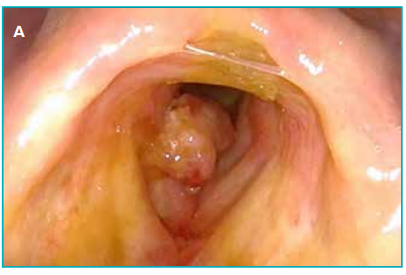
Figure 1A: Preoperative picture of right vocal cord growth
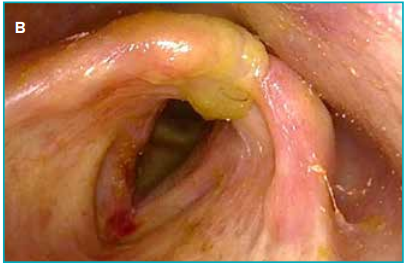
Figure 1B: Postoperative Day 7.
Two approaches were considered:
- Tracheostomy under local anaesthesia, followed by CABG and later removal of the laryngeal growth.
- Single-stage management with transoral carbon dioxide (CO₂) laser excision of the growth using a laser-compatible tube, followed immediately by CABG.
The second option was preferred to avoid tracheostomyrelated morbidity and prolonged recovery.
Operative details
Under general anaesthesia, a size 6 laser-compatible endotracheal tube was inserted. Using a CO₂ laser with a Linear AcuBlade (1 mm spot, 10 W power), the entire polypoidal mass from the right vocal cord was excised in toto. Haemostasis was achieved, and the glottic airway was significantly widened.
Subsequently, the laser tube was replaced with a standard size 8 endotracheal tube, and CABG with three grafts on a beating heart was performed under appropriate heparinisation. The surgery and recovery were uneventful.
Postoperative course
The patient was monitored in the intensive care unit. No airway bleeding or compromise was noted. Videolaryngoscopy performed the following day showed a well-healed right vocal cord and a patent glottic airway. He was successfully extubated with good phonation and oxygen saturation. The patient was discharged in stable condition, with improved cardiac function and normal voice quality.
Discussion
The coexistence of airway obstruction and IHD presents unique perioperative challenges. Airway manipulation in such patients may precipitate haemodynamic instability, while cardiac revascularisation under airway compromise carries significant anaesthetic risk.4,6
Traditionally, tracheostomy under local anaesthesia is used to secure the airway before cardiac surgery; however, it is associated with morbidity, including infection, bleeding, delayed decannulation, and long-term voice changes.7
In this case, transoral CO₂ laser excision provided a precise, haemostatic, and minimally invasive method to restore airway patency.8,9 The CO₂ laser’s ability to achieve haemostasis and minimise thermal injury makes it an ideal tool for delicate laryngeal work, particularly in patients with cardiac risk where prolonged procedures and bleeding must be avoided.10,11
Performing both surgeries in a single sitting reduced total anaesthetic exposure, hospitalisation time, and postoperative morbidity. The favourable outcome underscores the importance of a multidisciplinary approach, emphasising preoperative coordination and intraoperative communication between ENT, anaesthesiology, and cardiac teams.4,5
Acknowledgements
The authors acknowledge the contributions of the Departments of ENT and Cardiothoracic and Vascular Surgery, BLK-Max Super Speciality Hospital, Rajendra Place, New Delhi, for their teamwork and expertise in managing this complex case.
Conflict of Interest
None declared.
Conclusion
This case illustrates that simultaneous transoral CO₂ laser excision of an obstructive vocal cord lesion followed by CABG is feasible and safe when planned collaboratively. Avoiding tracheostomy minimised morbidity and expedited recovery. Such multidisciplinary teamwork is essential in managing patients with concurrent airway and cardiac disease.
WVBS Ramalingam, Neha Sood, Pratibha Desai, Ramji Mehrotra, Shailender Nath Sahay. Complex Case of Compromised Airway with Triple-Vessel Disease: Innovative Approach. MMJ. 2025, December. Vol 2 (4).
References
-
Eckel HE, Thumfart WF, Vokes DE. CO₂ laser surgery of the larynx—indications, techniques, and results. Eur Arch Otorhinolaryngol. 2000;257(5):270–7.
-
Jackowska J, Sjogren EV, Bartochowska A, et al. Outcomes of CO2 laser-assisted posterior cordectomy in bilateral vocal cord paralysis in 132 cases. Lasers Med Sci. 2018;33(5):1115–21.
-
Bukhari M. Laser excision of a large granular cell tumour of the vocal cord with subglottic extension: a case report. Open Med (Wars). 2025;20(1):20251250.
-
Wei C, Wreh D, Gressen J, et al. Anesthetic management of unanticipated subglottic stenosis in a patient undergoing coronary artery bypass graft surgery. Anaesth Pain Intensive Care. 2023;27(4):351–4.
-
Rogan C, Corbridge R. Airway management in otolaryngology and head and neck surgery: a narrative review. J Clin Med. 2025;14(13):4717.
-
Verma A, Hadaya J, Tran Z, et al. Incidence and outcomes of laryngeal complications following adult cardiac surgery: a national analysis. Dysphagia. 2022;37(5):1142–50.
-
Dhoon TQ, Ramezani A, Wong HS, et al. Laryngeal granuloma formation following endotracheal intubation for coronary artery bypass grafting surgery. Anaesth Pain Intensive Care. 2022;26(6):811–4
-
Filauro M, Missale F, Vallin A, et al. Functional outcomes after transoral CO2 laser treatment for posterior glottic stenosis: a bicentric case series. Eur Arch Otorhinolaryngol. 2023;280(1):249–57.
-
Balmert NJ, Duren D. Anesthesia for laryngeal surgery. In: StatPearls [Internet]. Treasure Island (FL): StatPearls Publishing; 2023.
-
Devesa PM, Ghufoor K, Lloyd S, et al. Endoscopic CO₂ laser management of laryngocele. Laryngoscope. 2002;112(8):1426–30.
-
Remacle M, Lawson G, Jamart J, et al. CO2 laser in the diagnosis and treatment of early cancer of the vocal fold. Eur Arch Otorhinolaryngol. 1997;254(4):169–76.