 WhatsApp Us (24/7)
 +91 926 888 0303 (24/7)


Abstract: Study design is the pre-set structure for collecting evidence to achieve a study’s stated objectives. The major types are descriptive, which focuses on studying the profile and distribution of the cases across different groups and subgroups, and analytical, which investigates antecedent-outcome relationships. Analytical studies can be either experimental, involving deliberate human intervention to alter the course of events such as a clinical trial, or observational, where naturally occurring events are studied for their relationships with one another. Observational studies can further be categorised as prospective, retrospective, or cross-sectional. This article provides an overview of these major study designs with a focus on the correct selection of each. Further details will be discussed in subsequent articles of this series.
Key words: Designs, Evidence, Descriptive Studies, Analytical Studies.
Introduction
Medicine is an empirical science and decisions are based on evidence, as there is no role for hunches or personal preferences in medical decisions. The nature of evidence is important, but the credibility of the evidence depends on the soundness of the methodology used for its collection. Design is the pattern, scheme, or plan to collect evidence. It is the road map by which the credibility of research findings is assessed. The function of a design is to permit valid and reliable conclusions that are justified and unbiased. The protocol detailing the study design provides clarity and permits conclusions to be drawn with due consideration of the confounding and other complications that might interfere with interpretation. Thus, the design should be able to provide correct answers to the research questions. The objective of a design is to get the best out of the efforts.
Design is in your hands – you decide how the data should be collected. Findings and results, however, are not in your hands – they come from responses over which you have no control. It is mostly due to the flaws in design that allegations of some treatments causing more harm than good, also called iatrogenic findings, come up.1 Various elements of design and their major types can be listed as follows.
Elements of a Study Design and Their Types
A study design contains the following elements:
- Definition of the target population, incorporating inclusion and exclusion criteria, the area from which subjects will be drawn, and their background information.
- Specification of various groups to be included and their relevance.
- Source and number of subjects to be included in each group with justification, including statistical power or precision considerations as applicable.
- Method of selection of subjects from those who meet the inclusion and exclusion criteria.
- Strategy for eliciting data — whether through an animal experiment or human trial, or observational study (prospective, retrospective
- Method of allocating subjects to different groups or matching criteria, with justification. Includes methods for blinding and other strategies to reduce bias, if applicable.
- Specification of intervention, if any, with justification.
- Identification and definition of the antecedents, outcomes, mediators, and confounders to be assessed and their relevance for the study objectives.
- Method of administering various data-collecting devices such as questionnaires, laboratory investigations, and clinical assessments; also includes methods for qualitative and quantitative measurements, including scoring.
- Validity and reliability of the different devices and measurements to be used.
- Time-sequence for collecting observations and their frequency (e.g., once a day, once a month), duration of follow-up, and duration of study, with justification.
- Methods for assessing compliance and strategies for addressing ethical concerns.
Types of Study Designs
We will discuss various types of designs in detail in subsequent articles, particularly those relevant to clinical studies, but for now, we will understand the broad types. These terms are sometimes incorrectly used.
Descriptive study
This study type examines the existing status of a disease or any other condition in different segments of population, or different types of cases, and their profiles. Associations between two or more factors can also be evaluated in a descriptive study without implying a cause-effect relationship.
Analytical study
This study type aims to establish relationships between two or more factors — generally antecedents and outcomes, or even cause-effect.
By observing natural course of events (observational study)
– Prospective: From antecedent to outcomes
– Retrospective: From outcome to antecedents
– Cross-sectional: When antecedents and outcomes are studied together
By human intervention
– Experiments on animals and biological material in a laboratory
– Trials on human participants in a clinic or community, such as for assessing the efficacy and side effects of a new regimen
An overview is shown in Figure 1. Note that there is a wide spectrum of study designs, and not all of them can be discussed in a single article of the present type. This article contains only an overview, which may differ from descriptions in some literature, as some books and articles do not provide a complete description of these designs.
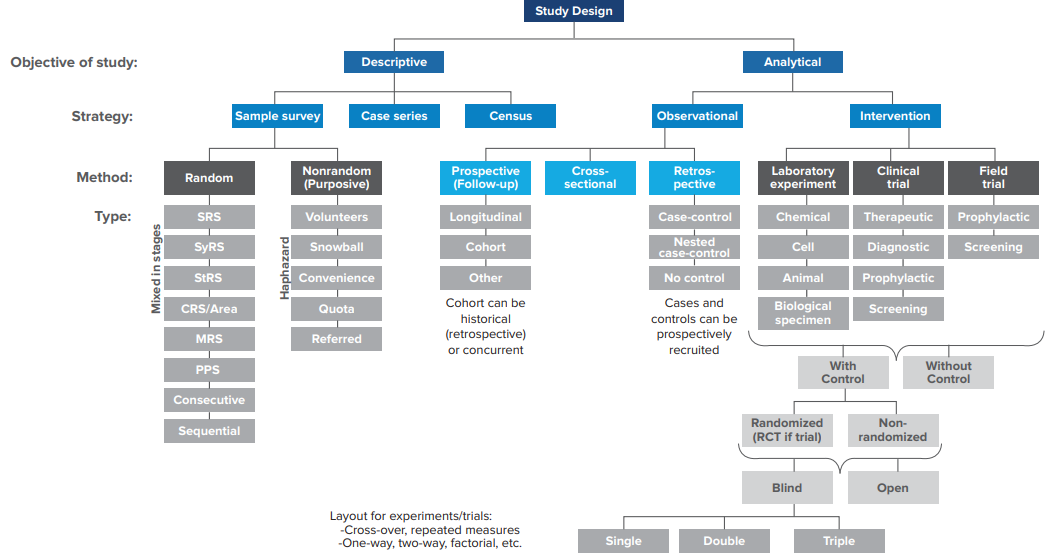
Figure 1: Various types of study designs.
Source: Adapted from Basic Methods of Medical Research, 3rd edition (AITBS Publishers, 2013) by A. Indrayan, with permission from the copyright holder.
Abbreviations: CRS: Cluster Random Sampling; MRS: Multistage Random Sampling; PPS: Probability Proportional to Size; RCT: Randomised Controlled Trial; SRS: Simple Random Sampling; SyRS: Systematic Random Sampling; StRS: Stratified Random Sampling.
Descriptive Study
A descriptive study covers the distribution part of epidemiology for a disease or a health condition, examining what is common and what is rare, where it occurs, and any observable trends. It helps to assess the types and severity of diseases prevalent in various groups, their burden on a community, and their clinical and demographic profiles. A descriptive study does not seek explanation or causes, or determine which group is ‘better’ relative to the other. For example, studies on growth parameters in children, or prevalence estimates of liver disease in obese individuals are descriptive studies. Unless the existing status is known, how can one find the cause? Unfortunately, even basic metrics like body temperature among healthy subjects are not known with precision for many populations. Thus, there is considerable scope for carrying out descriptive studies. Such studies can provide baseline data for launching programmes, such as oral cancer control, and for measuring achievements when conducted before and after a programme.
A descriptive study can also generate hypotheses regarding aetiology of the health condition under review, for example, when the disease is found to be more common in one group than another. In some situations, a descriptive study can be designed to test a hypothesis regarding status of a parameter, such as whether at least 80 percent of patients with abdominal tuberculosis present with long-standing abdominal pain, vomiting, and constipation, or whether prevalence of non-insulin dependent diabetes is at least 20 percent among married individuals aged 50 years or older whose spouse is diabetic. Descriptive studies can also be used to study relationships, such as between systolic and diastolic blood pressure (BP), or between haemoglobin and retinol levels, as long as these relationships are viewed as associations and not cause-effect links.
Case studies (or case reports), which generally describe features of a new disease entity, are also descriptive in nature. They present unusual and unexpected findings for one or a few cases. A series of such cases forms a case-series. These too can generate a new hypothesis. The case-series of HIV positive individuals in New York and California in 1981, which predominantly involved gay men, led to the suspicion that sexual behaviour could be a cause.2
Surveys too are descriptive studies, although this term is generally used for community-based investigations. Surveys are the primary format of descriptive studies, and when conducted repeatedly, they can reveal time trends. Complete enumeration, such as a population census or an audit of cases admitted to a hospital, is also descriptive in nature. A descriptive study generally includes only one group, since no comparison group is needed, though it may be divided into strata.
KalaBarathi et al.3 reported a descriptive study on exercise habits in middle-aged adults in Chennai. The design of a descriptive study is primarily concerned with the sampling plan to ensure that a representative sample is chosen from the target population. This requires random sampling, as listed on the left-most panel of Figure 1. Non-random sampling generally provides a biased set of cases and not appropriate for getting generalisable results. The article cited used non-random sampling – thus, their results are not generalisable.
Analytical Study
The other main type of study design is analytical, which aims to investigate aetiology or cause-effect relationships. Analytical studies help identify determinants of a disease or health condition and to evaluate differences between two or more groups. Although the conclusions are often associational, they carry overtones of cause-effect. An analytical study can indeed provide conclusions regarding cause-effect relationships when conducted rigorously, with careful control of the mediator and confounder variables.
Two strategies are available for analytical studies— observation and experiment. Observational studies examine naturally occurring events, such as the effect of hypothyroidism on diabetes control in diabetic subjects. There is no human intervention. Record-based studies also fall under this category. Observational studies can be further divided into prospective, retrospective, and crosssectional designs, as will be explained in a later article.
Experimental studies require deliberate human intervention to change the course of events. These include both uncontrolled and controlled trials, including randomised clinical trials (RCTs), which can be blinded or unblinded. Experimental studies can take various forms, such as factorial, repeated measures, pragmatic, multistage, superiority, and non-inferiority trials, each of which will be discussed later in this series.
Choice of the strategy for analytical studies
A good research strategy provides conclusions with minimal error within the constraints of funds, time, personnel, and equipment. One useful strategy that works in some situations is comparing the characteristics of a population with a high incidence of a condition to those with a low incidence. This approach helps identify the factors contributing to the differences. This is known as an ecological study. For example, Silva Filho et al.4 studied cervical cancer mortality in Brazil in relation to socio-economic and healthcare factors. As in this study, an ecological study compares group characteristics, and individuals as such do not have a role. A study that investigates the correlation between infant mortality rate (IMR) and per capita income in 27 major states of India would be an ecological study. The data in this study would pertain to the states and not individuals. Results of an ecological study cannot be automatically applied to individuals. Many researchers unknowingly make this assumption, which leads to what is called ecological fallacy.
In some situations, intervention is not feasible. For example, when investigating the relationship between smoking and colon cancer, intervening by exposing some people to smoking is not an option. Instead, observation of people who already smoke is the only viable choice. However, when establishing the efficacy and safety of a new drug, intervention in terms of administering the drug is essential. In this case, an observational strategy is not an option. While the role of potentially harmful factors is generally studied through observation, potentially beneficial factors can be studied using either strategy. For example, the effect of garlic on cholesterol levels5 could be evaluated by studying people naturally ingesting garlic in different amounts, as well as by asking people who almost never took garlic to consume it in a specified quantity for a period of time. Experiments have the edge in providing more convincing results, as they can be carried out in controlled conditions—thus a relatively small sample could be enough. However, they raise ethical and feasibility concerns.
Guidelines for choosing a strategy for analytical studies can be listed as follows:
- The strategy should be ethically sound, causing minimal interference in the routine life of the subjects.
- Generally, it should be consistent with the approach of other researchers in the field. If not, the new approach should be fully justified.
- The strategy should clearly isolate the effect of the factor under investigation from the effect of other factors in simultaneous operation.
- It should be easy to implement and acceptable to the system within which the research is being planned.
- Confirm that the subjects will sufficiently cooperate during the entire course of the study and provide correct answers.
- The strategy should be sustainable, so that it can be replicated if necessary.
Levels of Evidence
Different strategies for analytical studies provide different levels of evidence of cause-effect relationships. The hierarchy is represented in Figure 2. Expert opinion and case reports can be highly biased, while a double blind RCT has the least bias. However, no design, including an RCT, eliminates bias. Therefore, one should always be careful in interpreting the results of any study.
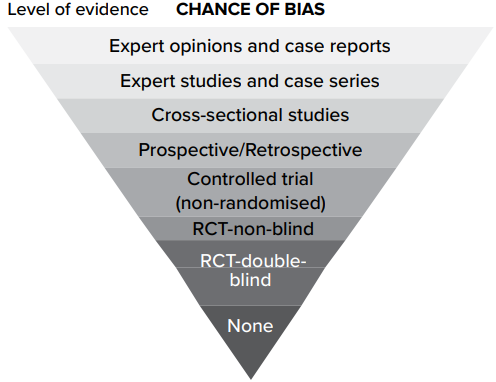
Figure 2: The pyramid of level of evidence in the context of types of designs.
Source: Basic Methods of Medical Research, 5th edition (AITBS Publishers, 2023) by A. Indrayan, with permission of the copyright holder.
Abbreviations: RCT: Randomised controlled trial.
Abhaya Indrayan. Research Methodology and Biostatistics Series IV - An Overview of the
Study Designs. MMJ. 2024, Dec. Vol 1 (4).
References
- Zhu Y, Xu H, Wang X. Optimized design of surgical steps in pars plana vitrectomy for macular hole retinal detachment in pathological myopia decreases rate of iatrogenic retinal break and shortens length of operation. BMC Ophthalmol. 2023;23(1):150.
- HIV.gov. A timeline of HIV and AIDS. Available at: https:// www.hiv.gov/hivbasics/overview/history/hiv-and-aidstimeline#year-1981. Accessed on: 7th October 2024.
- KalaBarathi S, Akshaya D, Kavitha M, et al. Assessing exercise habits of cardiovascular risks in Middle-aged adults: A descriptive study. J Pharm Bioallied Sci. 2024;16 (Suppl 3):S2003-5.
- da Silva Filho AL, Romualdo GR, Pinhati ME, et al. Exploring cervical cancer mortality in Brazil: an ecological study on socioeconomic and healthcare factors. Int J Gynecol Cancer. 2024:ijgc-2024.
- Vezza T, Guillamón E, García-García J, et al. LDL-cholesterollowering effects of a dietary supplement containing onion and garlic extract used in healthy volunteers. Nutrients. 2024;16(16):2811.